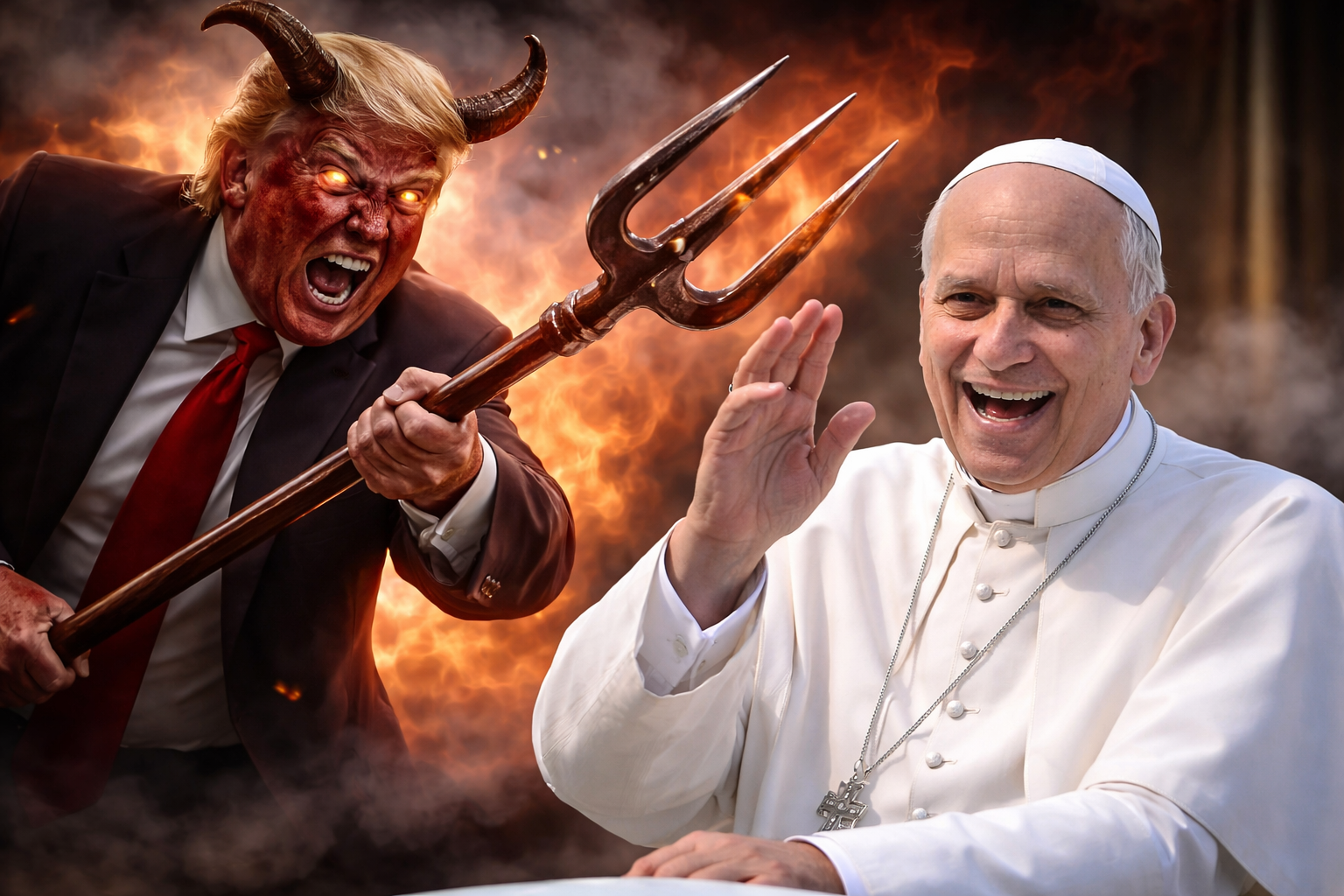

Pope Leo XIV has issued a sharp condemnation of the Trump administration’s current military campaigns and its stringent migration doctrine, describing them as contrary to humanistic values. Washington’s reaction was instantaneous: the American head of state characterised the Pontiff as a “terrible person.”
The situation took on an entirely surreal quality when the U.S. President posted AI-generated images on social media depicting himself in the messianic image of Jesus Christ, an act that sparked profound shock within the Vatican’s conservative circles.
Despite the seemingly anomalous nature of the current rhetoric, a survey of U.S. history reveals that the interaction between Washington and the Holy See has never been truly stable. The chronicle of their contact represents a complex mosaic of strategic alliances, protracted periods of mutual indifference, and critical diplomatic miscalculations.
The Path from Mutual Recognition to Official Rupture
The initial steps toward formalising relations were taken during the dawn of American statehood. In 1784, Pope Pius VI established the Apostolic Prefecture in the U.S., and five years later, the Jesuit John Carroll became the first American bishop, symbolising the Catholic world’s recognition of the new republic. However, as the U.S. strengthened during the 19th century, systemic contradictions began to surface.
A critical juncture occurred in 1863, during the height of the Civil War. Pope Pius IX, in an effort toward peacemaking, committed a grave political error: in an official missive, he addressed the Southern leader Jefferson Davis as the “President of the Confederate States of America.” The administration in Washington viewed this gesture as de facto recognition of the separatist regime’s legitimacy. The situation worsened in 1867 when false rumours regarding the closure of a Protestant chapel in Rome incensed Congress. The result was a ban on the budgetary funding of the diplomatic mission, plunging official relations into a state of suspended animation for seventy years.
The Era of World Wars and the Struggle Against Totalitarianism
The revival of dialogue occurred only in the mid-1930s. The 1936 visit of the Vatican Secretary of State, Eugenio Pacelli (the future Pope Pius XII), to the United States proved to be a turning point. His close, trusting relationship with Franklin D. Roosevelt facilitated the formation of a tacit but effective alliance against the rising totalitarian regimes in Europe.
Nevertheless, even a shared threat did not eliminate all friction. During the Second World War, the Vatican consistently called for peace negotiations and the maintenance of neutrality, while Washington uncompromisingly demanded Germany’s unconditional surrender. After 1945, the nature of the partnership shifted: amid the Cold War, papal nunciatures in Eastern Bloc countries evolved into “diplomatic outposts” for the Western world, ensuring information exchange behind the Iron Curtain.
Modern Challenges and the Religious Factor
The second half of the 20th century demonstrated the extent to which the internal American agenda influences relations with the Vatican. Paradoxically, the first Catholic president, John F. Kennedy, was forced to distance himself from the Holy See in 1961 to avoid provoking distrust from the influential Protestant majority, who viewed Catholicism as a threat to U.S. sovereignty.
Full diplomatic ties were officially restored only in 1984 under Ronald Reagan. For him, Pope John Paul II became a key ideological partner in the struggle against Soviet influence. However, with the end of the Cold War, issues of global ethics and law returned to the forefront:
- The Bill Clinton administration entered into open conflict with the Church over its support for the liberalisation of abortion laws at international UN conferences.
- John Paul II became one of the most consistent critics of the 2003 U.S. invasion of Iraq, challenging the legitimacy of “pre-emptive war.”
- Barack Obama faced systemic opposition from the episcopate regarding reproductive rights and health insurance mandates.
The Current Crisis and Accusations of Blasphemy
With Donald Trump’s return to the White House in 2025, the ideological rift between Washington and the Vatican has acquired an existential dimension. The appointment of Brian Burch—known for his radical critiques of the current Pope’s direction—as Ambassador to the Holy See served as a clear signal of the administration’s unwillingness to seek compromise.
By mid-2026, the conflict entered a phase of open confrontation following aggressive foreign policy actions by Washington, including military operations in Iran. Pope Leo XIV publicly condemned not only the disregard for international law but also what he termed the disturbing “self-deification” of the American president. President Trump’s use of the “Christ the Healer” imagery in political campaigning has triggered a global wave of blasphemy allegations.
Thus, the current standoff is not a random episode but the culmination of a centuries-long struggle for moral and political authority. When the White House oversteps the boundaries of traditional diplomacy and the Vatican appeals to higher ethical norms, the conflict inevitably transcends the limits of an inter-state dispute. The future of these relations now depends not only on diplomatic protocol but on the ability of both parties to acknowledge the separation of secular power and spiritual influence within a changing world order.

Latest Posts