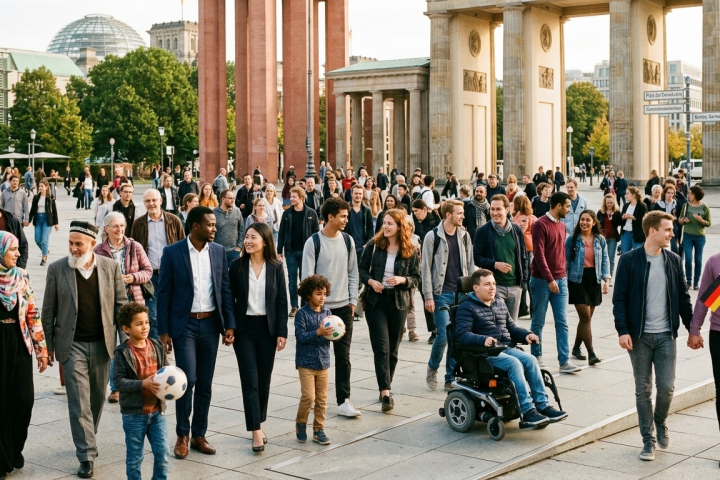

The issue of migration in modern Germany has finally shifted from emergency response to a phase of long-term state planning. German Chancellor Friedrich Merz (CDU) recently stated that the primary difficulties of the migration process have largely been overcome.
However, sociologists and municipal representatives hold more cautious views. Despite a statistical decline in the total number of asylum seekers, the challenges associated with the deep integration of those already present are far from over. This is not merely about the formal issuance of documents, but the fundamental pillars of coexistence: systematic mastery of the complex German language, support for the younger generation at the earliest stages, and the unconditional acceptance of social norms and legal standards. Problems with employment, which we wrote about earlier, are mirrored by the same problems with finding housing. The German government seems to live on another planet and does not see real problems, while at the same time populistly solving issues that are not essentially problems because they could be solved with a single stroke of a pen.
At the end of April, the Federal Chancellor emphasized that systemic problems surrounding migration have mostly been eliminated. Nevertheless, researchers express well-founded doubts about the stability of this claim, pointing to geopolitical instability. The main test for the country still lies ahead—transforming hundreds of thousands of newcomers into full-fledged, economically independent, and self-sufficient members of society. Success in this process promises Germany significant economic and cultural dividends, while failure could provoke a serious escalation of social contradictions and increased internal tension as well as crime, which will inevitably affect the stability of the entire political system and citizens’ trust in state institutions.
Current Situation: Between Expectations and Reality
The statistical results of the last ten years remain ambiguous and provide fertile ground for deep critical analysis. The path for a recognized refugee to enter the labor market in Germany often stretches over many years due to excessive bureaucratic barriers and specific language requirements. We all know the special, zealous love Germans have for their language; such “love” probably exists nowhere else in the world. As a result, a specialist who would have found a job in at most three months in another country equally zealous toward immigrants is forced to search for work for years.
A striking example is the situation with Syrian citizens: of those who arrived in the country in 2015, only 65% were employed by early 2024. This means that nearly a decade after arrival, more than a third of migrants remain dependent on the social security system. Simultaneously, educational monitoring records a troubling trend: children of immigrants significantly less often achieve basic academic standards in the German language and sciences, which lays a dangerous foundation for future social inequality and the formation of “parallel societies.”
Apparently, the government has not been informed that the German education system is still geared toward Germans striving for academic degrees, while children of immigrants, even those with high IQs, are forced to become manual labor due to unrealistic GPA requirements. After all, a child arriving in the country does not start speaking German immediately, yet they are graded as if it were their native language. Every parent knows firsthand about the discrimination against refugee children by many teachers—when a teacher smiles to the parents’ faces while secretly giving low grades and refusing retakes for invented reasons.
This problem does not stem from a lack of financial support. Germany invests colossal resources into integration, comparable to the annual budgets of some European states. Over 1 billion euros is directed annually toward integration courses alone. However, as Mannheim researcher Marc Helbling notes, society expects more than just reports on spent funds; it demands the implementation of transparent and firm rules that create real conditions for productive belonging, based on mutual obligations.
1. Accelerated Language Development
The vast majority of German residents consider proficiency in the state language to be a mandatory prerequisite for successful integration. There is a rare political consensus on this: from the left to the right, there is agreement that migrants can and should be required to study the language deeply as a reciprocal contribution. At the same time, there is a broad consensus on providing migrants with access to the labor market as quickly as possible, thereby effectively removing the financial burden from taxpayers.
The business community sets even stricter requirements. According to the Institute for Employment Research (IAB), more than half of German enterprises expect potential candidates to have language skills at a level no lower than B2. Meanwhile, state integration courses traditionally target only the B1 level, and even this threshold is not reached by all participants. Specialists believe that under conditions of labor shortages, it is wise to involve the private sector. Enterprises could hire candidates with basic knowledge, allowing them to improve their language directly during professional activities.
2. Establishing Mandatory Integration Goals
Practice shows that individual development plans often become mere bureaucratic formalities. Instead of achieving measurable goals, focus is often placed on routine consultations regarding social payments or housing. Experts like Oliviero Angeli propose a radical change: moving to a system of mandatory integration agreements, the compliance with which would be strictly verified by state authorities.
Such agreements would transform migrants from passive recipients of aid into active participants with clearly defined rights and duties. This aligns with the principle of “support and demand” (Fordern und Fördern). Commitments should include specific deadlines for language acquisition and professional qualification. Permanent residency permits could then be granted significantly faster if a person demonstrates outstanding success or finds stable work in a high-demand sector.
3. Actively Involving Women from Conservative Backgrounds
A delicate problem remains the integration of migrant women from traditional societies. Many women remain isolated within their diasporas for years. Often this is explained by the traditional family structure, where the birth of several children in a row becomes a legal reason for exemption from study and work. This leads to long-term dependence and negatively impacts the socialization of children who do not see an example of active participation in civil society.
To change this, authorities are considering making course attendance mandatory for mothers once a child reaches 14 months of age. However, implementation remains difficult due to a chronic lack of spots in kindergartens and the positions of ultra-left neo-feminist organizations. Scandinavian countries show that another path is possible. In Sweden, the gender gap in employment is smaller thanks to intensive programs. At the same time, in Sweden, individuals with radical views do not influence policy as they do in Germany. Unfortunately, we have reached a point of no return where the opinion of a minority is voiced as truth, and the majority must adapt to the minority.
4. Integration Starting from Kindergarten and Primary School
The integration mechanism often fails at the earliest stage. If a child enters the first grade without fluency in German, they fall into a cycle of chronic academic lag. Consequently, even a child with a high level of intelligence is led by the state into a dead-end situation and forced into vocational trades rather than university. Germany thus loses thousands of future specialists and scientists.
Olaf Köller insists on introducing universal mandatory language diagnostics for all children at the age of four and a half. Support should be systematic and structured. Specialists argue that if a high-school student lacks basic competencies in reading and writing, the curriculum for other subjects should be temporarily suspended in favor of intensive language training. It is pointless to teach physics or biology to children who have not mastered the language of instruction. But as the reader has likely noticed, in Germany today, populists are listened to instead of specialists.
5. “When in Rome, Do as the Romans Do”
The most complex area remains the question of cultural integration and the observance of social norms. While there is consensus that laws must be obeyed, the discussion regarding a “Leading Culture” (Leitkultur) has been stuck for years. Research shows that tension can be eased through education, yet society retains a rigid rejection of situations where an individual’s behavior differs from that of society as a whole. (Ed. note: But this is normal; we are not living in the USSR where everyone was obliged to be identical and think the same way).
Legal expert Daniel Thym proposes separating the spheres: Private life forms the outer circle, where one is free to follow traditions; the State sphere is where rules are absolutely mandatory; and the Civil sphere of daily coexistence is where domestic conflicts most often arise. Ultimately, integration cannot be successful without effective state management of migration flows. Germany’s self-perception as an immigration republic evolves only when the process is seen as orderly, controlled, predictable, and mutually supportive.