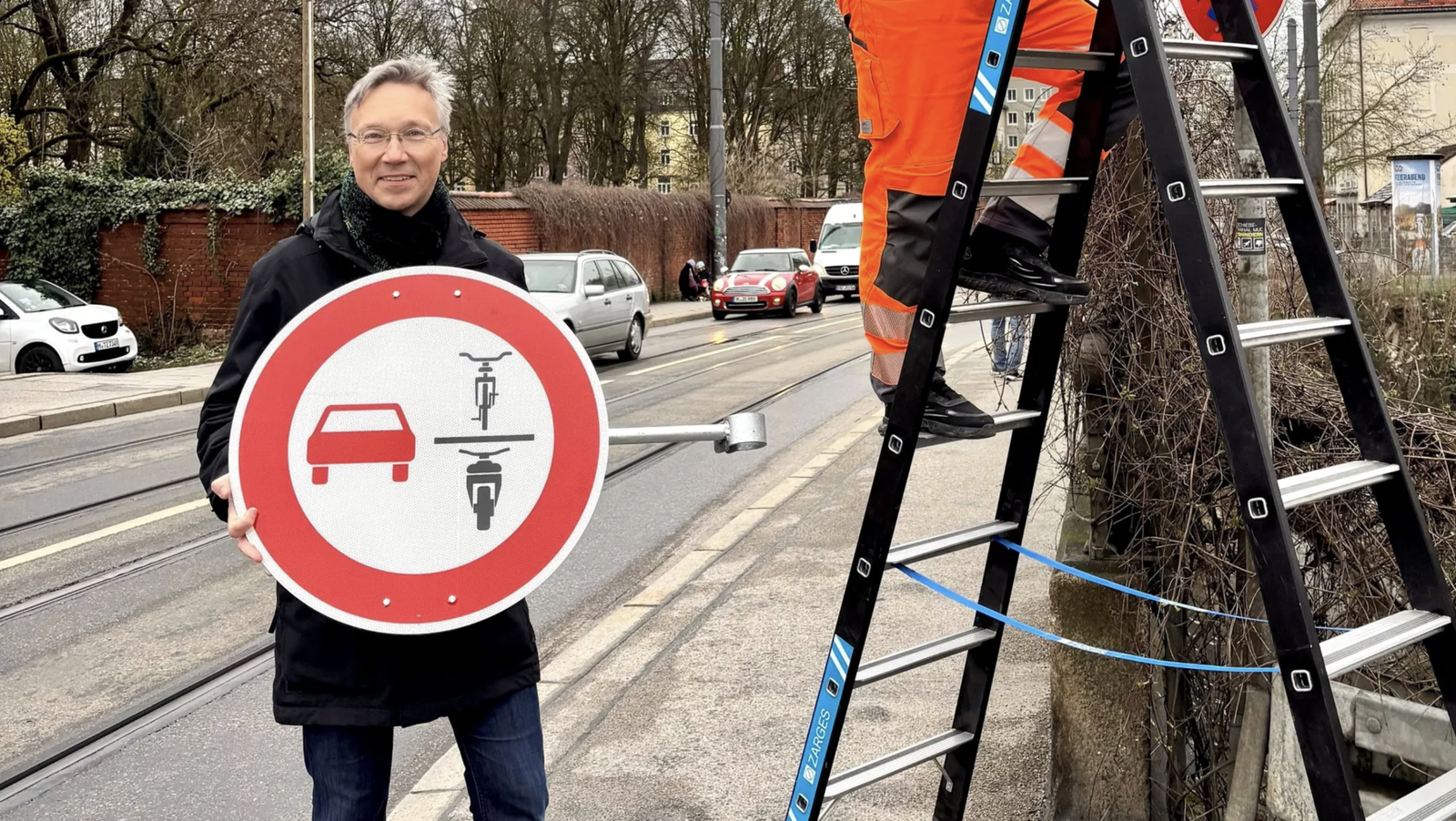

This new regulation applies to a critical section south of Hindlmayrstraße heading toward Tegernseer Landstraße in the Giesing district.
The decision stems from a long-standing challenge in road urban planning: the narrow width of the roadway in this specific area makes it physically impossible for motor vehicle drivers to maintain the legally required minimum distance of 1.5 meters when overtaking.
On the other hand, it is often cyclists who brazenly violate traffic regulations, respecting neither speed limits nor the required distance from the kerb—to the point of ignoring traffic signals entirely. Yet, for some inexplicable reason, city authorities continue to ignore this fact and fail to take measures even to fine offenders, let alone provide training for those cyclists who are particularly unwilling to learn traffic rules and laws. Of course, it is far easier to simply prohibit something than to treat the actual symptom of the malady.
To eliminate risks to the safety and well-being of all road users, the municipality has opted for a decisive and logical step — a total ban on overtaking two-wheeled vehicles in this zone.
The situation in this area has remained problematic for years. A combination of factors — narrow sidewalks, the inability to allow bicycle traffic in pedestrian zones, and a severe lack of space for a designated protective bike lane — had turned the bridge into a high-risk zone. Furthermore, the tram tracks running directly through the center of the road further constricted the space available for maneuvers. Previously implemented measures, such as a 30 km/h speed limit, solid lane markings, and a safety island, failed to yield the desired results. In practice, drivers continued to perform risky overtaking maneuvers, often veering into oncoming traffic or dangerously closing the gap with cyclists.Eliminating the “Grey Zone” for Public Safety
The installation of the new traffic sign is intended to finally eliminate any legal or practical ambiguity on this challenging stretch of road. Georg Dunkel, the Mobility Commissioner, explained that the new sign leaves no room for misinterpretation: “Overtaking cyclists here is now strictly prohibited.”
According to Dunkel, the introduction of these signs in Munich is part of a broader strategy to humanize the urban environment. City officials are confident that a clear visual prohibition will significantly enhance both subjective and objective safety levels for cyclists, minimizing conflicts and accidents in the city’s logistical bottlenecks.

Latest Posts