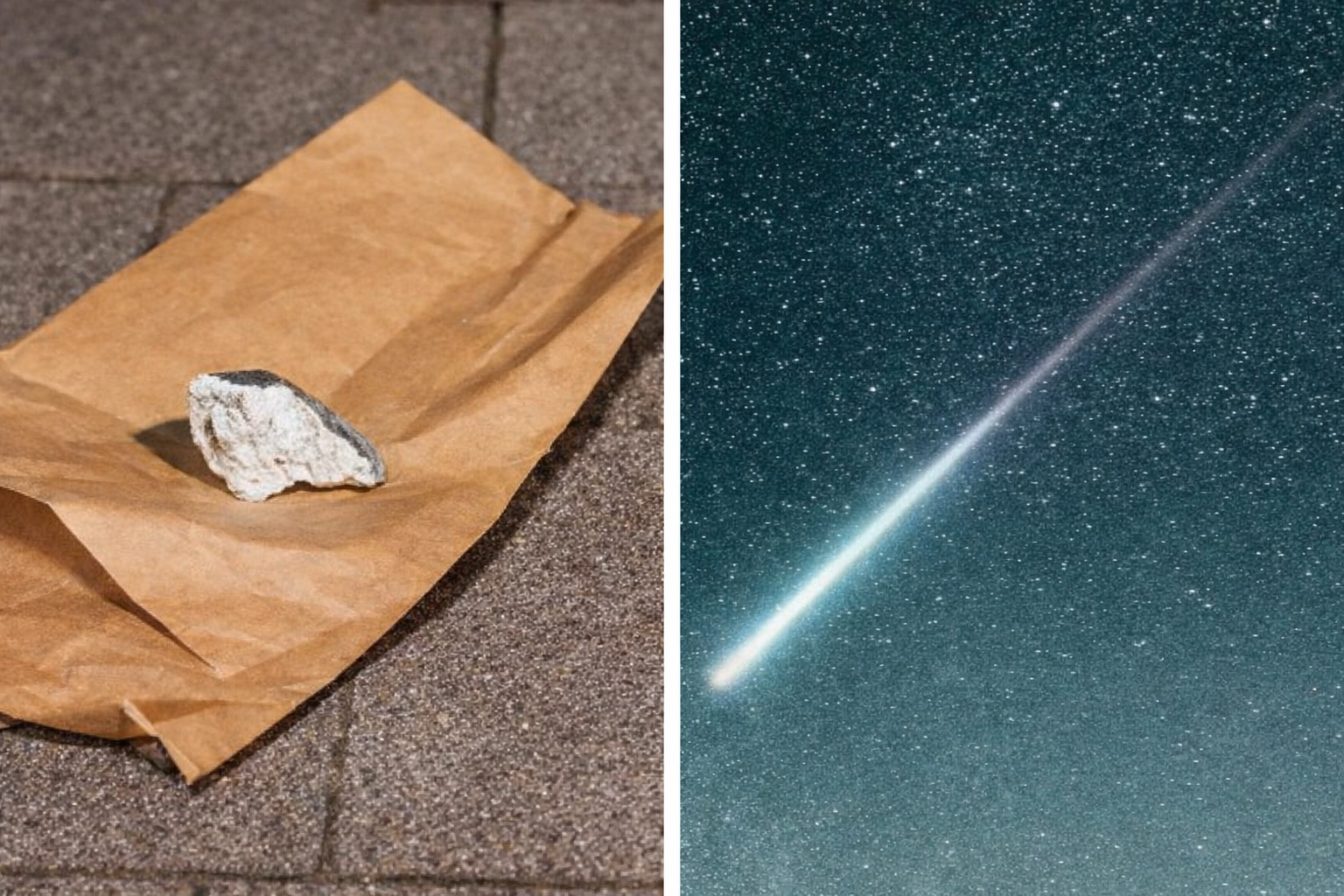

In the Güls district of Koblenz, an ordinary Sunday, March 8, 2026, ended with serious damage to a private home: a glowing object that survived the Earth’s atmosphere pierced the roof, leaving a neat, football-sized hole. By a stroke of luck, the residents were in an adjacent room at that moment, so there were no injuries. Police arriving at the scene found fragments of extraterrestrial rock, sand, and characteristic dust on the floor — undeniable traces of a cosmic visit. Similar reports of bright flashes and rumbles also came from the Hunsrück and Eifel regions, confirming that meteorite falls are a regular phenomenon to which Bavaria has a very direct connection.
Cosmic statistics: eight confirmed strikes in Bavaria
When an asteroid collides with the Earth’s air envelope at enormous speed, it undergoes colossal loads and disintegration. Most of the celestial body burns up, creating a shooting star effect, but the most resilient fragments reach the surface. These surviving pieces are officially called meteorites and are entered into the international Meteoritical Bulletin Database.
According to the Bavarian State Office for the Environment, eight officially recognized cases have been recorded in the territory between Upper Franconia and Swabia where scientists managed to find physical material from the “invader.” Experts emphasize that there is far more evidence of falls, but it is not always possible to find fragments in forests or fields. Today, automated observation cameras recording bolides come to the rescue: using their data, it is possible to calculate the trajectory and landing site of another celestial wanderer with high precision.
Chronicle of Bavarian meteorites: from museum exhibits to garden decorations
If a celestial body is found, its fate often turns out to be quite unusual. Here are the most notable cases in Bavaria‘s history:
- Eichstätt (1785): A cosmic guest weighing 3.2 kilograms crashed directly into a brick shed on a secluded farm. The stone turned out to be so in demand that it was broken into small pieces that same year. Today, “fragments from Eichstätt” are kept in the largest collections in the world — from Vienna and Zurich to London, Paris, and New York.
- Mässing (1803): A stone weighing 1.6 kilograms fell shortly before Christmas. Curiously, one of the tiny fragments of this meteorite has been kept in the Vatican collection since 1935. In 2002, Pope Emeritus Benedict XVI, born just 30 kilometers from the fall site, examined this sample with special interest.
- Untermässing (1920): This iron giant lay under the roots of an old spruce for about 14,000 years until it was accidentally found in 1920. The meteorite miraculously escaped being melted down and survived the bombings of World War II. Today, its main part, weighing more than 78 kilograms, is exhibited in Nuremberg.
- Machtenstein (1956): Perhaps the most curious story. A farmer’s son found an unusual heavy stone during field work. Not realizing the value of the find, the family used the 1.4-kilogram meteorite as an ornament for the front garden. Only in 2014, almost 60 years later, was the “stone” identified and sent for examination.
- Neuschwanstein (2002): This case could have been a tragedy for world culture. Several large fragments were rushing toward the ground at a speed of more than 200 kilometers per hour. Calculations showed: if not for a strong headwind that slowed and deflected the fragments, they could have crashed directly into the famous “fairytale castle.” Snowdrifts gently cushioned the meteorites, keeping Neuschwanstein Castle unharmed.
Issigau-Reitzenstein (2020): The absolute record holder of Germany. During excavation work in Upper Franconia, a block with a mass of 136.4 kilograms was extracted from the ground. This dark brown giant measuring 60 x 35 centimeters fell to Earth thousands of years ago but, thanks to its dimensions, became the largest find in the country’s history.

Latest Posts