
The driverless passenger transportation project is in the preparatory stage, as the partners still need to obtain official permits from regulatory authorities. Launching the pilot program in a European metropolis will allow for an assessment of the software’s readiness to operate in a dense, historic city center; however, the technology developers will have to take into account the strict safety standards adopted in the EU.
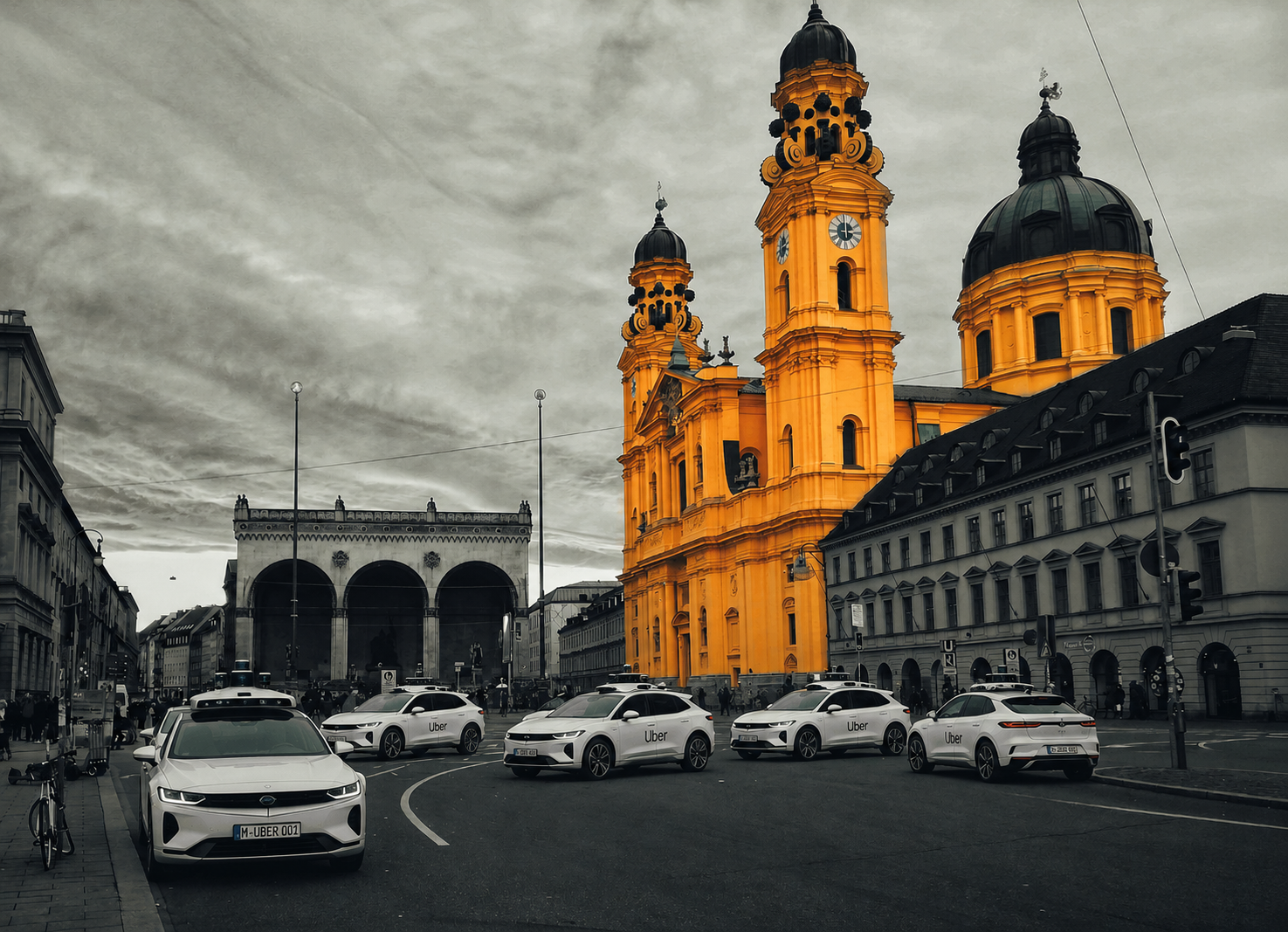
Uber and the Israeli artificial intelligence developer Autobrains plan to create a fleet of autonomous taxis in Munich. Representatives of both companies announced this on Monday, June 1, at the GTC technology conference in Taipei. The parties concluded a partnership agreement with the aim of organizing the test operation of vehicles on the territory of the Bavarian capital.
The organizers of the project call Munich the launching pad for the deployment of their global program. The choice of the city is driven by the high density of automobile traffic, a developed infrastructure, and the presence of leading German automakers. Germany’s current legislation in the field of autonomous driving also served as an important factor in the decision-making process. Nevertheless, for the vehicles to actually hit the streets, the companies still need to receive official approvals from the relevant departments.
Issues of Organizing Test Rides of Autonomous Taxis in Munich
According to the project participants, the technological foundation for the new system will be a computing platform from the chip manufacturer Nvidia. The partners intend to develop a so-called open software model that can be integrated into production cars of various brands. Vehicles manufactured by Audi, BMW, Mercedes, and Volkswagen have been named as potential platforms, which underscores the project’s orientation toward integration into the existing European automotive industry.
The management of Uber and Autobrains also clarified that the project involves the use of vehicles with the highest level of automation, which requires no control or attention from a driver at all.
For the purpose of conducting the tests, it is planned to define a specific geographical zone within which the autonomous vehicles will circulate — for example, certain sections of the Mittlerer Ring ring road. More detailed information regarding the boundaries of this zone is currently unavailable, as the routes are undergoing the approval stage in municipal services.
Foreign Competitors Encounter Transport Problems
In countries such as the United States and China, other developers have advanced further in the practical application of autonomous transport. There are already metropolises there where autonomous cars perform commercial trips within certain districts and are available for passengers to order. In the American market, Google’s subsidiary corporation under the name Waymo operates in several major centers, including San Francisco, Phoenix, Atlanta, Austin, and Nashville.
Passengers can book rides between designated points via a mobile application, by analogy with Uber or Bolt services, provided that the entire route takes place within an agreed zone. However, as the geographical presence of such taxis expands, the number of disruptions in their operations recorded by city services also increases. Instances occur where clients find themselves locked inside the cabin because the vehicle’s navigation system cannot adjust the route in areas where roadworks are being carried out. Situations involving street blockages are also recorded, when several Waymo cars stop on the roadway with their engines running, obstructing the passage of local residents.
A dangerous situation arose in early March following a shooting in the city of Austin, Texas. A Waymo autonomous vehicle attempted to perform a U-turn at a gathering point of patrol cars and blocked the movement of an ambulance that was heading toward the victims. The medical vehicle was able to continue moving only after a police officer manually moved the autonomous taxi aside.
In conclusion, it should be noted that the initiative of Uber and Autobrains in Munich marks an attempt to bring autonomous technologies onto a conservative European market characterized by strict regulatory requirements. The experience of operating similar services in the US demonstrates that the integration of artificial intelligence into the urban environment is accompanied by unforeseen logistical and technical disruptions, especially in emergency situations. The success of the Munich experiment will directly depend on the developers’ ability to adapt the software to complex infrastructure scenarios and guarantee the unhindered operation of city rescue services.