
Munich — The city system of accommodation for migrants has faced the necessity of a large-scale and forced restructuring. The temporary shelters for refugees remaining in the capital of Bavaria will cease to function already this coming autumn. Such a decision was approved by the committee for social issues of the city council, of which the Munich city administration officially reported. The main trigger for such radical steps was the complete cessation of refinancing of these objects on the part of the government of Upper Bavaria, which is legally secured from December 31. The municipality had to respond operatively to the new economic realities in order not to permit a critical load on the local budget. But it is still not clear where exactly the residents of these shelters will be resettled.
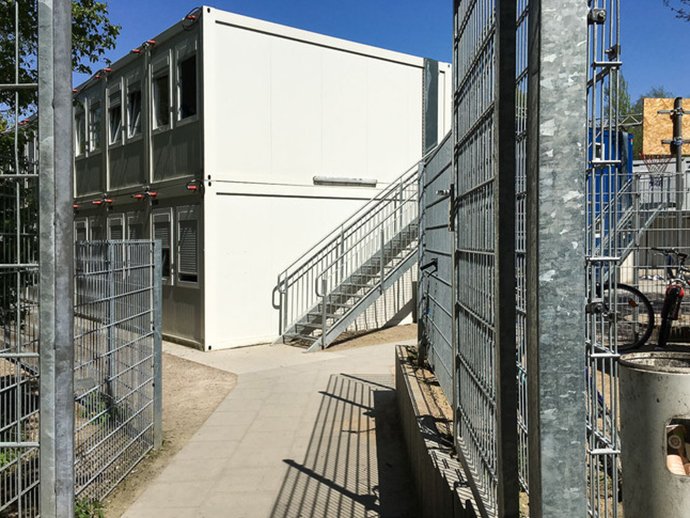
For example, in November 2026, the refuge at Rambergstraße 6 falls under eviction. The residents were notified about this already in the spring. But up to now, no one has explained to the residents of the refuge what will happen if by November they do not find housing independently. On the one hand, the law obliges the authorities to provide a premises no worse than the one used. On the other hand, the experience of evicting residents of refuges in the past shows that the authorities treat them permissively and resettle refugees, many of whom already have jobs, have settled in with things, have pets, etc. — back into general camps. Often not even in the Munich area, which complicates the life activities of those who already integrate into German society with difficulty due to many external factors about which we wrote earlier.
To the request of the editorial office about the existence of at least some strategy, we received a boilerplate response that the Government of Bavaria is doing everything possible to improve the quality of life of refugees. Although the facts show a completely different reality.
The problem with Rambergstraße 6 and other refuges could have been solved a long time ago.
- In other refuges, rooms are constantly becoming vacant, and instead of settling people from the outside there, the authorities could resettle the residents of the refuges that are awaiting closure one by one over half a year, i.e., carry out the closure gradually without detriment to the residents.
- As is known from journalistic investigations, in Munich, because of chaos in the operation of the SOWON system or political factors, thousands of units of social housing have been idling for a long time. Low-income people complain that it is already visible to the naked eye that the same objects constantly rotate in the system of social housing distribution. And apartments are distributed among units, usually among disabled people and families with small children. Instead of the classical lawful system of housing distribution according to two queues, we have a system when 99% of those in need continue to live at the poverty level, and the city gives apartments only to units, keeping the rest simply empty. Why shouldn’t the Department of Social Security distribute the vacant apartments to those whom in the coming months they themselves plan to evict onto the street? Or is this not advantageous politically?
The Social Administration Closes Temporary Refuges for Refugees — the Permission for Two Objects Has Been Extended
Nevertheless, the city authorities made an important tactical exception for two objects by the committee for social issues. The temporary refuges on Gerty-Spieß-Straße 9–11 and on Maria-Goeppert-Mayer-Straße 21 will cease to be populated in the routine mode from 2027; however, the structures themselves will not be dismantled.
Now municipal services are studying in detail the variants of conservation of the existing infrastructure. This step will allow the city to insure itself and operatively respond if the intensity of the arrival of refugees suddenly increases or a new migration wave covers Europe.
The head of the social administration, Dorothee Schiwy, emphasized that the experience of recent years has visually proved the impossibility of accurate long-term forecasting of humanitarian flows. Precisely because of this, Munich is obliged to combine strict planning with maximum managerial flexibility, preserving a strategic reserve.
New Housing with a Capacity of Up to 300 People Is Planned on Drygalski-Allee
In parallel with the liquidation of temporary locations, the authorities are unfolding a program for optimizing the permanent city infrastructure. The strategy implies not simply closing old addresses, but transferring the entire system onto long-term rails. Within the framework of this process, the operation of current reception points for refugees is extended, and simultaneously modern decentralized capacities are being created.
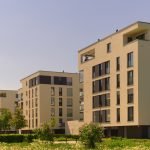
In particular, on Drygalski-Allee, the erection of a new residential complex is planned, which will be able to comfortably accommodate up to 300 people (out of tens of thousands of those in need? This is a zilch, and not a solution to the problem, all the more so since the complex has not even begun to be built yet — Ed.).
In parallel, the functioning of several more sites is being extended, and the premises themselves are being modernized and adapted to current standards of cohabitation. Now, according to the persons responsible for housing, instead of one person in a room of 10 square meters, up to 4 people will reside — geniuses of optimization…
The Primary Reception Point for Ukrainian Refugees Will Move Before the End of 2026
The approved plan also regulates in detail the fate of the decentralized primary reception point for Ukrainian refugees on Dachauer Straße 122, which will close at the end of 2026.
Further extension of the lease agreement for this territory has been recognized as impossible, since, according to official data from the federal authorities, this real estate object is necessary for the state for its own needs.
Profile subdivisions are already carrying out an active selection of an alternative site capable of painlessly accepting the entire infrastructure of this center.
By the realization of this complex of measures, the Munich municipality expects to guarantee a stable, predictable, and high-quality accommodation of arriving persons in the long-term perspective, excluding chaos and spontaneous decisions. Without having announced by what method they plan to do this.
Source: Municipality of Munich

Latest Posts