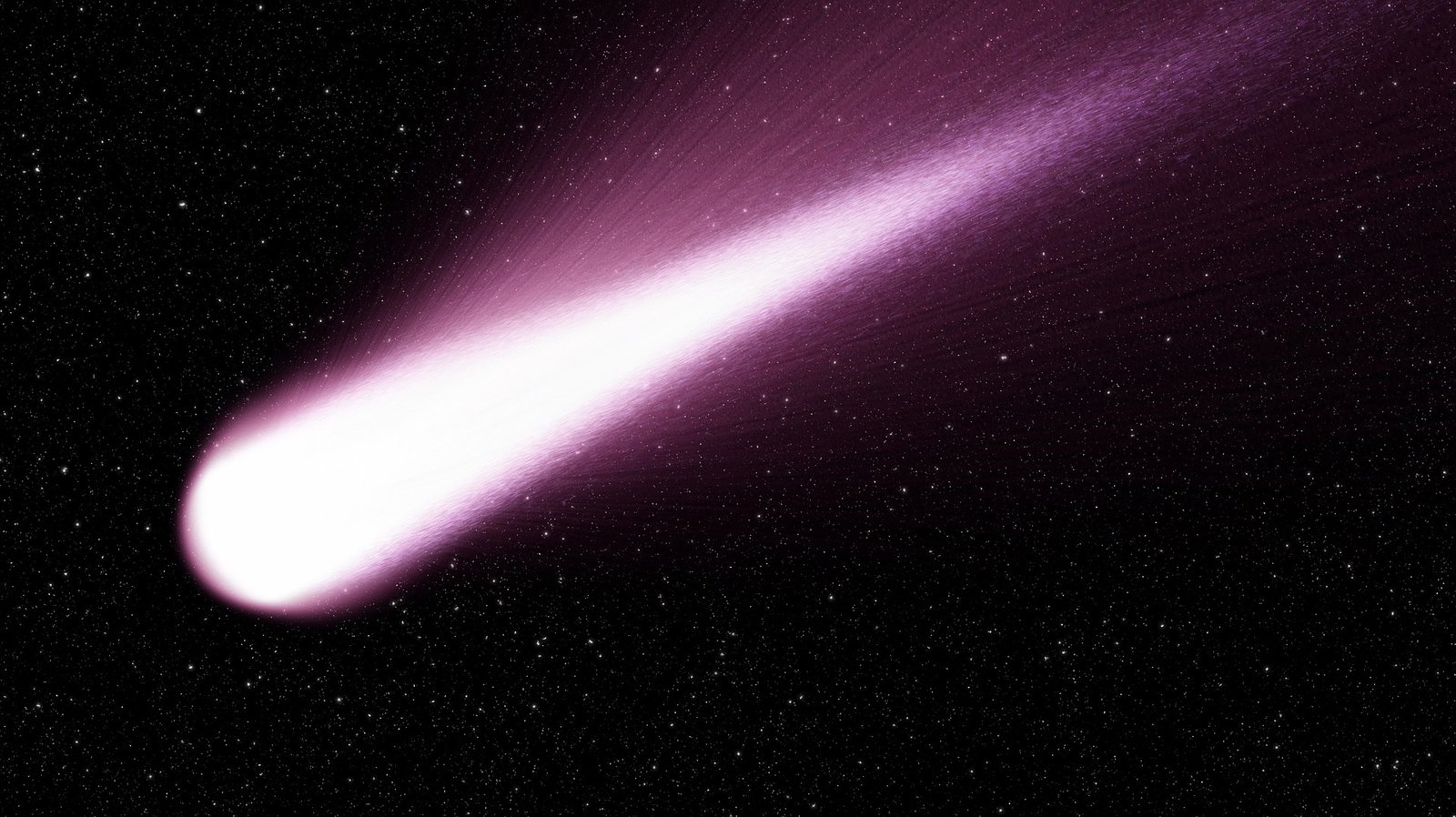

The global scientific community is now focused on the trajectory of this icy wanderer, as the outcome of its close encounter will determine whether it becomes the brightest object of the year or vanishes without a trace in the solar corona.
Starting Saturday, April 4, Marco Sproviero—a leading observer at the Deutsches Museum Observatory—will begin scanning the horizon just after sunset. Even for seasoned researchers, exact predictions are elusive. “At this stage, it is essentially a high-stakes cosmic gamble,” Sproviero noted. The comet is expected to pass a mere 162,000 kilometers above the Sun’s surface—a distance that, in astronomical terms, is practically a “brush.”
Will Comet C/2026 A1 (MAPS) Disintegrate Near the Sun?
The primary risk lies in the extreme temperatures and immense gravitational forces. Harald Krüger, an astrophysicist at the Max Planck Institute for Solar System Research, emphasizes the potentially fatal nature of this “hellish flight.” The comet’s nucleus is a fragile conglomerate of ice and dust; thus, the probability of its disintegration is high. Researchers admit that without a detailed understanding of the nucleus’s chemical composition and density, predicting its survival is impossible. We are poised to witness either a grand destruction or the birth of a new celestial legend.
Origins: The Kreutz Group and the “Sungrazers”
The comet’s name follows a rigorous nomenclature: “C” denotes a non-periodic comet, “2026 A1” marks the timing of its discovery (early January), and “MAPS” represents the observation program founded by four dedicated amateur astronomers. The object belongs to the Kreutz group—fragments of a massive celestial body roughly 100 km in diameter that shattered thousands of years ago. In astronomy, these are known as “sungrazers” because their orbits bring them perilously close to our star.
Will We See a Brilliant Tail?
Should the nucleus of C/2026 A1 survive this fiery passage, a spectacular show awaits, comparable to comets NEOWISE (2020) or Lovejoy (2011). As the ice sublimates, vast amounts of gas and dust will be thrust into space, forming a brilliant, elongated tail visible to the naked eye.
Observation Guide:
- When to Watch: Starting April 4, immediately after sunset.
- Where to Look: Low on the western horizon. Use the brilliant Venus as your celestial guide in the twilight.
- Safety Warning: It is strictly forbidden to look at the Sun (especially through binoculars or a telescope) before it has fully set. Doing so can cause permanent blindness.
If the weather remains cloudy, the comet can be tracked online via the SOHO solar telescope (an ESA/NASA project). Even if the comet fails to survive, astronomy enthusiasts have another event to look forward to: on August 12, 2026, a partial solar eclipse will be visible in our latitudes.

Latest Posts