
While Bavarian Prime Minister Markus Söder should have focused on fulfilling his direct duties and strengthening citizen trust through real actions, he dedicated a significant part of his time for two consecutive years to media activity of a questionable nature.
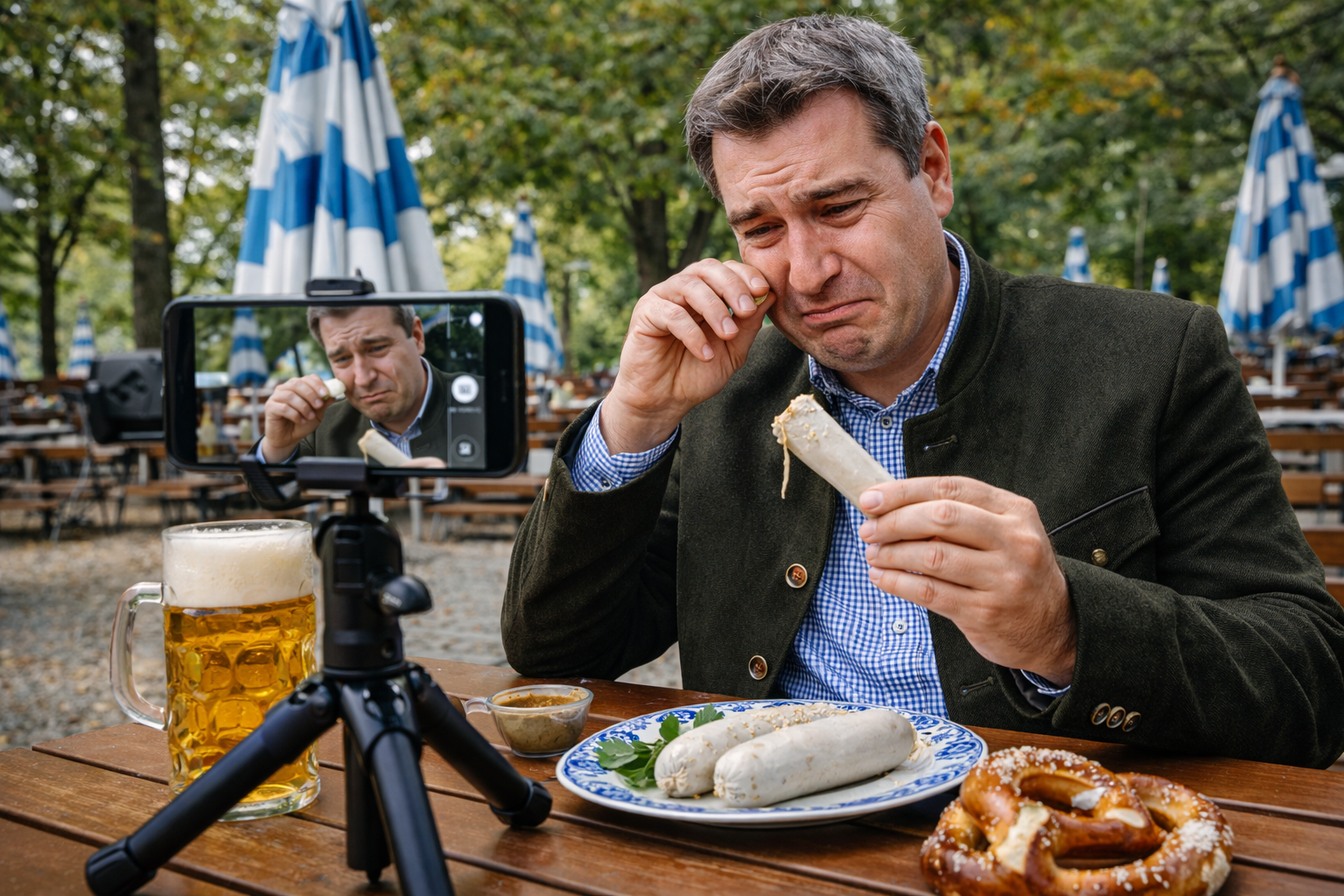
The head of the region actively developed his food blog, frequenting restaurants and publicly evaluating the quality of shawarma and white sausages, and regularly appeared on broadcasts of a television channel effectively under his control.
In addition to gastronomic pursuits, Söder became infatuated with Donald Trump-style rhetoric. By trying to hijack the agenda and electorate of the Alternative for Germany party through loud and sharp statements, he achieved the opposite effect — alienating his own traditional supporters while maintaining the growth of his competitors’ popularity. Bravo, Markus! Now the AfD might become the main beneficiary of this strategy.
A few days before the decisive vote, the situation for the CSU looks alarming. According to data from a fresh representative survey at the municipal level, the party still holds the lead, but its support has dropped to 33%. This is clearly demonstrated by the results of the Wählercheck study, prepared specifically for the 17:30 SAT.1 Bayern program. The municipal elections, scheduled for March 8, will be a serious exam for the current government, as in 2020 the CSU result was higher and amounted to 34.5%.
Breathing down the leader’s neck is the AfD, which occupies second place with 14%. For this political force, such a figure means a grand breakthrough compared to 2020, when they gained a modest 4.7%. At the same time, the Free Voters demonstrate stability, claiming 11%, which is only slightly lower than their past result of 11.9%.
The political crisis has also affected other major forces. The Greens, who showed a record 17.5% six years ago, can now count on only 10%. The Social Democrats from the SPD risk collapsing to 8% against the former 13.7%. Other race participants — The Left, SSW, FDP, the Bavaria Party, and ÖDP — are balancing on the edge of statistical error, gaining from 1% to 2%.
Survey on preferences in state elections gives CSU 39%
A somewhat different picture is observed in the classic survey regarding preferences in the Landtag elections. Here, the CSU feels more confident, demonstrating a result of 39%. Subsequent positions were secured by the AfD (18%), the Greens (13%), and the Free Voters (10%). The SPD settles for 7%, while The Left, FDP, and SSW gain between 2% and 3%.
It is worth remembering that any pre-election measurements of public opinion are always associated with a certain degree of uncertainty. Sociologists note that the party affiliations of Bavarian residents are weakening, and the final decision on voting is made in increasingly shorter timeframes. This seriously complicates the work of research institutes, as data quickly loses relevance. In principle, the published figures reflect only a momentary snapshot of moods and are not a final forecast of the election outcome.
The Wählercheck study was conducted by the Hamburg-based public opinion research institute GMS. During the work, a representative telephone and online survey was conducted, in which 1,003 Bavarian residents participated between February 25, 2026, and March 2, 2026.Source: dpa

Latest Posts