
High-ranking guests were scheduled to visit Munich on Wednesday: as Telekom planned the opening of the new facility, Bavarian Prime Minister Markus Söder and Vice-Chancellor Lars Klingbeil traveled to the state capital. With this initiative, Telekom expects to compete with major American service providers.
The project was first announced last autumn when Telekom representatives reported a close partnership with Nvidia. This collaboration was essential as the center requires approximately 10,000 graphics processors to function. On Wednesday, February 4, Telekom CEO Timotheus Höttges presented the project in Munich’s Tucherpark, representing an investment of around one billion euros.
A Billion-Euro Facility in the English Garden
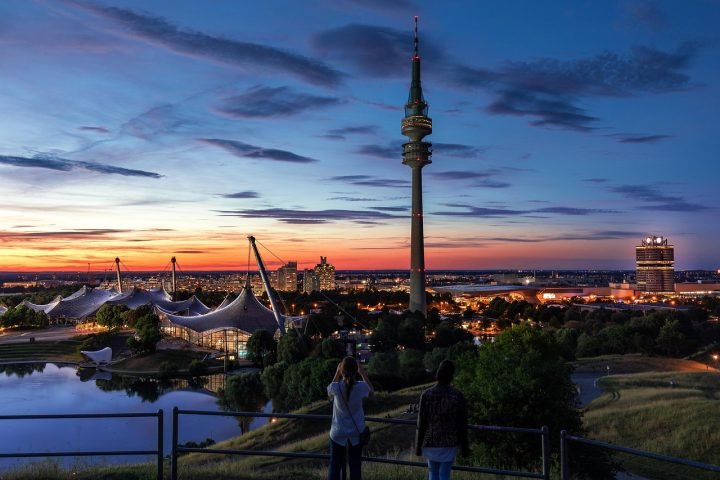
Tucherpark is located in central Munich, directly adjacent to the English Garden. The entire area has been undergoing redevelopment, with many buildings from the 1960s receiving major renovations. In addition to the construction of 600 new apartments, plans included the modernization of existing office spaces. The new center was placed in one of these—the former Hypovereinsbank building.
The computing complex occupies six underground floors in the Tucherpark quarter, making the installation virtually invisible from the outside. To cool the high-performance chips, Telekom engineers designed a system to use cold water from the nearby Eisbach stream. Furthermore, there are plans not to simply discard the generated heat but to feed this energy into the local heating network to warm the residential district.
Strategic Location and Industrial Demand
The choice of Munich as the construction site was driven by the high concentration of potential industrial clients. Entities such as Airbus, BMW, and Siemens, as well as robotics companies, require minimal latency for data transmission. Placing the center in the heart of the city ensures the necessary high-speed connection parameters.
In the competitive struggle against large American players, Telekom is betting on data sovereignty. Many German enterprises have shown caution regarding placing sensitive information in cloud services provided by U.S. suppliers. Instead, Telekom offers a sovereign cloud concept, where information physically remains in Germany and is protected under European and German law.
Enhanced Control for German Companies
When using American providers, legislative norms such as the US Cloud Act theoretically allow U.S. authorities access to data. This is the fundamental difference in the proposal from the Bonn-based company. Thus, Telekom has targeted a niche in the cloud segment by locating secured capacities near major industrial hubs.
With the launch of this facility, Telekom expects to become one of the leaders in computing capacity in the country. For comparison, Germany’s largest supercomputer, Jupiter, at the Jülich Research Centre, possesses 24,000 graphics processors. Höttges first announced this joint project with the American chip manufacturer Nvidia in November of last year.Source: t-online

Latest Posts