
And today we will talk precisely about this political alliance. After all, the CSU is a party where leadership directly determines the vector of development not only of the party itself, but at the moment also of the entire Free State, and even, boldly speaking, of the entire federal politics of Germany.
Klaus Holetschek personifies that seriousness which his leader — Markus Söder — is now trying to demonstrate en masse in public, although the latter is doing it very poorly.
And what, actually, is happening?
After the summer recess in the parliament’s work, a fundamental dispute may arise between the two politicians from the Christian Social Union. For a thinking voter, it is obvious that behind the external well-being of the party tandem lies a deep divergence of two management concepts: expressive populism and pragmatic technocratic realism.
The beer tent is the natural habitat for a classic Bavarian politician, a kind of barometer of his electoral potential. A brass band creates the familiar festive atmosphere, and numerous visitors on long wooden benches eagerly await policy speeches. Markus Söder knows how to emotionally and filigree fire up such a specific audience. The Prime Minister of Bavaria speaks at folk festivals in an emphasized sharp, assertive, and straightforward manner, which does not suit all representatives of the moderate electorate. The People’s Food Blogger often changes the essence of his words, adjusting to various, including radical, views. As a true populist, he instinctively feels what his voters want to hear. And, unlike the middle and upper classes of society — thinking, educated people who are not easily deceived by beautiful speeches — the regulars of beer tents are not famous for critical thinking, and very willingly believe in any “beautiful” promises. This is what Söder takes advantage of, just like any other populists in our World.
Klaus Holetschek looks much calmer, more restrained, and more moderate against his background. He does not attract instant attention to himself with loud slogans, but represents a reliable intellectual alternative. The current chairman of the CSU parliamentary group in the Landtag (regional parliament) consistently demonstrates a strict businesslike approach, which Söder now has to adopt with visible difficulty for the sake of preserving the fading political balance.
A changeable spring evening in provincial Nördlingen clearly illustrates these tectonic shifts in party culture. The voluntary fire brigade of the Baldingen district is celebrating its 150th anniversary. This is the last of five planned festive days. Fatigue is noticeable perhaps only from the appearance of some honored firefighters, but the attendees do not lack stamina and perseverance: the huge tent is completely filled with people. Right in front of the stage, a note with a concise text is fixed on one of the central tables: “Reserved for the CSU.”
Previously, such an unwritten rule actually and undividedly extended to all key political positions in the Ries region. However, in recent years, the oldest party has been gradually but irreversibly losing its monopoly positions. In the office of the Landrat (head of the district administration), a representative of the “Free Voters” party has already been officially present for several days, replacing the CSU administration, which ruled here continuously and terribly inefficiently for 24 years.
Outside, before the main performance, a local musical orchestra is rehearsing, which on previous evenings invariably gathered hundreds of residents. Members of the festival committee in traditional Bavarian dirndls await the high-ranking guest from Munich. Only schoolgirls with big white bows on their heads and a red ribbon, which the “valuable guest” must cut to the accompaniment of the orchestra, are missing. If our favorite Food blogger (Söder) visited the event, this would be a reality, but…
Klaus Holetschek is 61 years old, he was born in Lower Bavaria, built a successful political career in Swabia, worked for a long time as a mayor in Allgäu, held the responsible post of Minister of Health of Bavaria during the most difficult period of the pandemic, and now heads the largest parliamentary group in the Landtag. He fundamentally does not arrange ceremonial, theatrical exits to the public, but calmly moves in a dense flow of people until he finds himself at the very rostrum.
On the stage, welcoming speeches of officials continue, and in the hall, traditional treats are promptly served to the guests. Then a solemn march sounds. Two female participants of the festival politely accompany Holetschek to the desk for speeches. At this very moment, complete silence is established in the tent. After many years of familiar, expressive, and emotionally charged speeches by the former party leaders, a legitimate question arises among some thinking attendees whether an effective political format is possible at all in Bavaria without the use of harsh polemics, aggressive lobbying, and mutual accusations.
Holetschek is Considered as a Possible Successor to Söder
Recently, Markus Söder has also been trying to look emphasized statesmanlike, climbing out of his skin, trying to broadcast the image of a wise national leader. Söder is not ashamed to use the administrative resource, as well as his remaining influence on the editorial policy of the BR24 TV channel, which he headed earlier. But, difficult times require a serious and balanced approach to state planning. However, for the main chairman of the CSU, this new political tone comes at the cost of significant internal self-control and the breaking of his usual role, while at the same time Holetschek simply remains himself under any circumstances. “We must make sure that we do not divide our world only into black and white,” he notes in a balanced way in his speech. And harshly adds: “We just need to act here and now. I no longer want to hear endless explanations of why something is impossible to do.”
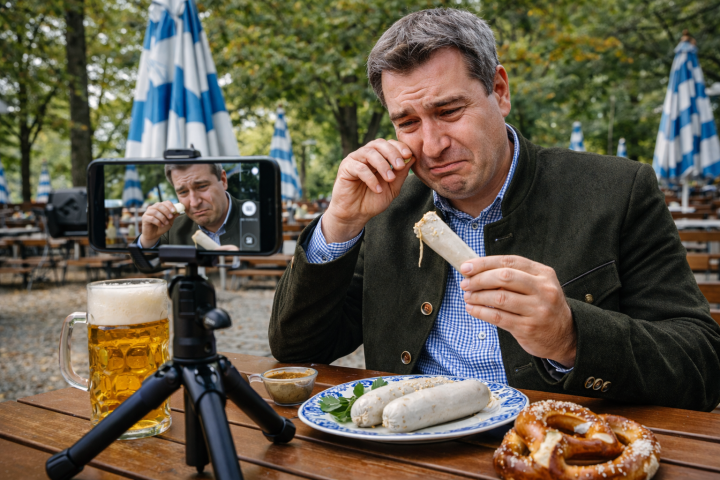
The public in the tent responds to these words without stormy, staged ovations, without large television close-ups focused on certain faces, without a woman’s tear after the speech of the “leader” — shown on the whole screen, but reflectively ponders over what was said. At the same time, pragmatic citizens think about how accurately this balanced politician responds to the deep demands of a society alarmed by crises. Is he capable in the medium term of posing real competition to his immediate leader, who is busy with reviews of Bavarian sausages in various establishments and invented achievements voiced in thousands of interviews, with a complete lack of performance of his official duties?
Until now, open rivalry between them has not been observed solely due to the different levels of their current political influence. Söder grants Holetschek wide freedom of action in the Landtag, and the latter responds with absolute apparatus loyalty. For example, this week he was the first of the party elite to publicly react to the sharp criticism of the Prime Minister by the influential Deputy Chairman of the CSU Manfred Weber.
The politicians call each other almost every morning, often even before seven o’clock, to promptly discuss the work agenda or exchange remarks. Söder always calls first, striving to control the situation. A reliable and predictable ally capable of promptly controlling current legislative processes is necessary for him, since the electoral weight of the first person is gradually decreasing, and in the corridors of the party they are beginning to openly discuss possible scenarios for the development of events after the departure or even removal of Markus Söder from his post.
In Holetschek’s public behavior, signs of radicalism or impulsiveness are completely absent, which appeals to the moderate middle class. However, experts expect him to openly declare his leadership ambitions in the event of a long-term loss of confidence in Söder within the CSU itself or during his hypothetical transition to federal work in Berlin. In the post of Minister of Health, Holetschek became widely known far beyond the borders of Bavaria thanks to systemic crisis management, and recently he has been regularly and weightily speaking out on key topics of federal policy.
Perhaps, a hidden preparation for large-scale personnel shuffles is underway now, because not only the political future of Söder is being discussed in the party corridors, but also the positions of his long-time rival Ilse Aigner, who, according to analysts, claims the high post of Federal President. Holetschek remains a key systemic figure under any development of events. When one of the capital’s journalists publicly called him the most likely successor, the politician himself reacted to this with restraint and diplomacy, neither confirming nor denying this assumption.
He knows perfectly well how painfully and sensitively Markus Söder reacts to the appearance of any potential competitors in his information field. After all, fear of competition is one of the first indicators of autocrats and populists. And this fact is perfectly understood in the ranks of the CSU.
On the other hand: in the long history of the CSU, a peaceful and conflict-free transfer of power has never been a common practice. In the coming months, independent observers will especially closely monitor the personal and apparatus interaction of Söder and Holetschek, especially since a point of possible open disagreement capable of destroying the fragile compromise is already clearly planned in the political calendar of Bavaria.
Probability of Resuming the Discussion on a Coalition with the “Greens”
After the summer recess, the parliamentary group in Kloster Banz intends to discuss in detail at a closed meeting how strategically correct the leadership’s decision was to rigidly link the party’s political prospects exclusively with the “Free Voters.” Holetschek does not plan to artificially restrain this complex and painful discussion. This step is dictated by the urgent need to promptly respond to the tangible loss of the CSU’s positions in the local elections in Swabia, where he personally heads the district branch of the party. In his strategic activity, Holetschek openly focuses on the traditions of Alois Glück, who in the era of the authoritarian Edmund Stoiber successfully strengthened the independence and subjectivity of the parliamentary group.
A particular sharpness and drama is added to the situation by the fact that in the event of a theoretical rejection of the current partnership with the “Free Voters”, the only mathematical alternative for forming a stable government will remain an alliance with the “Greens” party. Markus Söder previously led such a harsh, aggressive, and uncompromising campaign against this political force that it caused complete dissatisfaction and criticism even among his traditional supporters from among the city millionaires.
In this connection, vital questions arise before the party: is the current Prime Minister ready to radically change his rhetoric for the sake of the possibility of pragmatic work with the “Greens”, or in such changed conditions will the CSU require a completely different, more moderate leader for the transition period? A suitable candidate, as we see, for this responsible role in the party certainly exists, and his influence continues to grow steadily.
Summing up, it can be stated that the emerging confrontation within the CSU reflects a deeper crisis of identity of the oldest party in Bavaria. For an audience with critical thinking, it is obvious that the era of monopoly dominance of bright populist leaders is gradually giving way to a demand for stability, professionalism, and business transparency. The ability of the CSU to adapt to these requirements and determine the true role of Klaus Holetschek in the party hierarchy will show whether the alliance can maintain its political leadership in southern Germany in an era of global turbulence.