
The Munich City Council has officially approved a comprehensive development plan for the strategically important territory of the former post office, which is taking legal effect after years of inter-fractional discussions and expert approvals. This decision marks the transition of one of the region’s most ambitious and simultaneously resonant construction projects into the practical stage of implementation. In this regard, legitimate questions arise before the expert community and the public about exactly how this large-scale construction project will develop in the coming years and when specifically the first technical works can begin on the construction site.
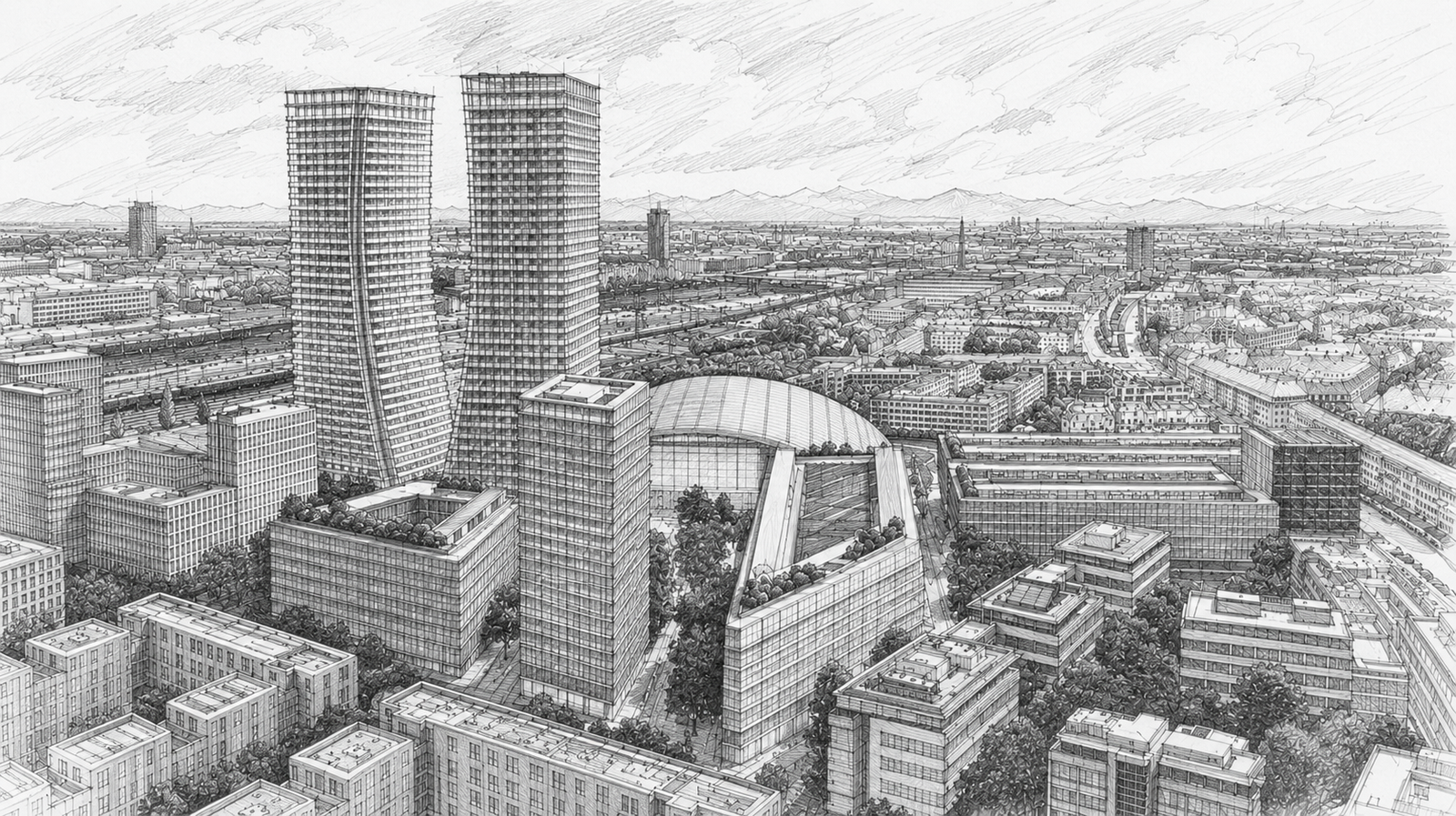
The history of this project clearly illustrates the complexity of balancing the interests of major investors, municipal authorities, and local residents in modern Germany. It has been about seven years since well-known Bavarian investor Ralf Büschl first submitted his initial plans for the long-term development and revitalization of the vast territory of the former post office to the relevant authorities for consideration. The project stipulates that in the immediate vicinity of a busy transport hub—the Friedenheimer Brücke bridge—it is planned to erect two dominant buildings, each 155 meters high, which are designed to become the architectural core of a fundamentally new urban quarter.
At the time, these high-rise intentions sparked stormy public discussions, repeatedly became the subject of fierce debates in the city council, and nearly led to a city-wide local referendum whose initiators opposed violating Munich’s historical silhouette (however, in the end, the plebiscite was barred on legal grounds). Now, after overcoming the main administrative barriers, the project has come one step closer to actual realization. On Wednesday, the city council took the final decision to publish the approved development plan—as officially reported by the municipal planning department, this step is expected to take place on June 30. From that moment on, the regulatory plan will officially enter into legal force, fixing the new urban planning parameters of the site.
Project Scale and Urban Environment Concept
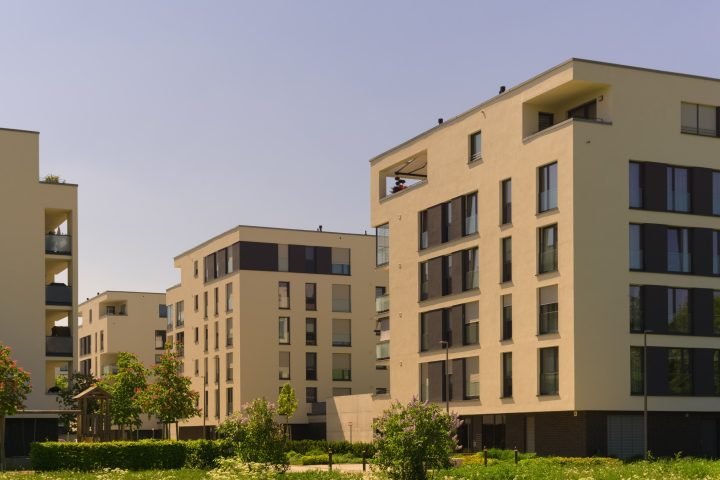
The Büschl group of companies intends to deploy construction works on a territory comparable in size to twelve football fields. According to the approved project documentation, the developer plans to build a total of 1,190 modern apartments, which will be located both in the two residential high-rises and in the adjacent buildings of lower height. An important social component of the project, which helped gain the support of the center-left wing of the city council, was that almost half of this housing stock volume will be subsidized by the state, providing affordable housing for middle-income families. In addition, provision is made for the creation of about 55 apartments with reduced long-term rental costs, intended specifically for representatives of socially significant professions—medical workers, teachers, and emergency services personnel.
In addition to the residential function, the new quarter is designed to become a major economic cluster: the implementation of the project will allow the creation of modern jobs for approximately 3,000 people, which will reduce commuting in this area. At the same time, the developer undertakes obligations to preserve the historical heritage: inside the monumental building of the old post office, which is officially under strict state protection as an architectural monument, it is planned to organize a multifunctional cultural space. As an element to attract tourists, they intend to open the city’s highest beer garden at the top of one of the high-rise buildings. The Büschl group of companies positions this project as a benchmark model of modern urbanism—a 15-minute city where housing, workplaces, healthcare facilities, leisure centers, and retail outlets are closely linked by a single pedestrian infrastructure and create a high-quality, vibrant urban environment.
What Happens Next and When Will Construction Begin?
The procedure for the development plan entering into force opens the opportunity for the investor to transition to detailed design. As soon as the document is officially published, the investor intends to promptly conduct the remaining specialized architectural competitions. These are strictly prescribed by the active urban development contract with the municipality and must definitively determine the aesthetic appearance of the facades, as well as the configuration of the lower parts of the buildings. Meanwhile, the recognizable geometric shape and the maximum height of the 155-meter towers themselves, according to an official representative of the Büschl group, have already been definitively approved today and are not subject to change.
If the subsequent stages of design proceed strictly according to the set schedule, the results of the final architectural competition will become known to the expert community at the end of this year. Based on this data, the Büschl group of companies expects to prepare and submit final applications for obtaining official building permits in 2027. Immediately after their approval by supervisory authorities, full-scale construction works can begin on the site. It is planned to fully complete and commission the entire multifunctional facility by 2033, with complex underground engineering works and foundation preparation alone expected to take about a year.
What Future Awaits the Backstage Cultural Center?
At this stage, the city planning department no longer foresees systemic legal risks for the approved development plan. Nevertheless, according to Bavarian law, opponents of the project retain the right to attempt to challenge this municipal regulation within a year through standard judicial review procedures to verify its compliance with federal building codes.
Regardless of this legal aspect, one social issue remains open and highly acute, which was also discussed in detail on Wednesday at the city council meeting: the long-term fate of the well-known Backstage cultural center, located directly next to the borders of the future large-scale construction. The management of this popular alternative center openly fears that the multi-year large-scale construction and subsequent neighborhood with luxury housing could place the very existence of their concert venue under direct threat, primarily due to inevitable complaints from future residents of the new buildings regarding increased noise levels in the evening hours.
In the Munich City Council, members almost unanimously agreed that this iconic site of the city’s cultural life must be preserved in its current form. Sybille Stöhr from the Green Party faction, which solidly supported the post office territory development project, noted separately in her speech: “We fully support Backstage and strategically want to keep it on the city map. Investor Büschl gave his official word not to file counter-lawsuits related to the center’s activities.”
Simultaneously, the planning department reports that to minimize conflicts of interest, the cultural center must promptly obtain official permission for its own planned reconstruction costing several million euros—and this must be done before the post office territory development plan officially enters into force, in order to secure the center’s status as an existing commercial facility.
Nevertheless, the management of the cultural space itself remains skeptical. The long-time head of the Backstage cultural center, Hans-Georg Stocker, called the city council’s current compromise decision an outright slap in the face for his establishment in his official statement, one that will significantly complicate its future operational and financial position in the market: “Now, in the current situation, I am forced to hope only that Mr. Büschl will fully deliver on his verbal promises and demonstrate social responsibility.”
In conclusion, it must be emphasized that the case of the former post office territory development in Munich reflects a global trend of major European cities creating hyper-dense, multifunctional quarters with a high-rise dominant. The success of this large-scale project’s implementation will depend not only on the investor’s compliance with the announced deadlines until 2033 but also on the ability of municipal authorities to effectively balance the interests of the new owners of subsidized housing and the established urban cultural ecosystem represented by the Backstage center, which will become an important precedent for future renovation projects in Bavaria.

Latest Posts