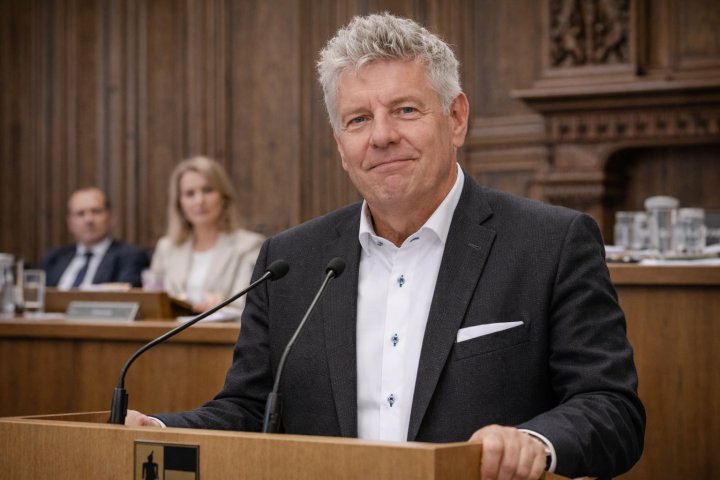

The prolonged pause in determining the city’s management vector has ended. According to information from the publication tz, elected Lord Mayor Dominik Krause officially held final coalition negotiations with the “Greens/Pink List” fractions, the SPD, and the political alliance of the FDP/Free Voters. Thus, Munich has received its own version of a “Traffic Light” coalition, which will define the life of the metropolis for the next six years.
Dominik Krause Forms Government with Liberals and Free Voters
This decision was the result of a long marathon of meetings and consultations held in an atmosphere of strict secrecy. Although Krause’s victory in the second round of elections on March 22 was convincing, the question of who would share the burden of executive power with him remained a subject of discussion for a long time. Munich’s political environment offered two main scenarios: a “Kenya” alliance (Greens, CSU, and SPD) or the formation of a “Traffic Light” by attracting liberal forces in the form of the FDP and Free Voters.
Initially, Dominik Krause did not hide his desire to maintain continuity and continue working within the framework of the already existing union in the City Hall between the Greens, SPD, and the Volt party. This configuration was considered a priority, and initial negotiations were conducted in this vein. However, a week and a half ago, the Volt fraction left the negotiation process. In the City Hall’s backrooms, it was discussed that the four deputies from this pan-European party put forward conditions that their partners considered excessively arrogant. According to available information, the Greens and SPD were ready to hand over the management of strategically important departments of economy and IT to Volt representatives. Nevertheless, fraction leader Felix Sproll allegedly demanded control over another department, which became a point of no return and led to the termination of the dialogue.
Following Volt’s Exit, Krause Found New Partners to Govern Munich
The forced change of course compelled Krause to quickly seek new points of support. An intensive search for partners began on Monday, April 20. First, communication took place with the FDP and Free Voters, and as early as Wednesday, a thorough meeting with CSU representatives was held, lasting more than four hours.
Thursday was dedicated to repeat consultations with the liberals, which this time took only 90 minutes. By Friday, the new mayor had held a series of internal discussions within the ranks of his own Green Party, where the need to adjust the terms of a future agreement emerged.
The main stumbling block during the negotiations was housing policy—a critically important topic for the Greens and Social Democrats. During his election campaign, Dominik Krause pledged to build 50,000 new apartments in Munich, and finding a compromise on this issue with liberal forces required additional effort. The climax occurred on Sunday: after two parallel meetings with the FDP/FW and CSU, which lasted until late evening, the parties only distributed a brief statement at 10:46 PM. It spoke of a constructive and result-oriented atmosphere, but specifics appeared only the following day.
Protracted Negotiations: “Traffic Light” and “Kenya” Each Had Supporters and Opponents
The length of the discussions was explained by fundamental differences in the proposed management models. The “Kenya” political alliance was considered by many political scientists as the most stable option in terms of a majority. In the case of a union between the Greens, SPD, and CSU, Krause would have relied on 56 out of 80 seats in the City Council. However, this scenario had many critics. Concerns were raised about the risk of political stagnation: forces so different in their views could simply block each other’s initiatives. Additionally, the CSU, with their 19 mandates, would inevitably have demanded key positions and the post of another mayor.
In the end, the choice in favor of the so-called “Traffic Light” proved tactically more advantageous for Krause. Despite the fact that the FDP and Free Voters have only five deputies, this allows the Greens and SPD to maintain leading positions in the distribution of offices. The downside of this decision will be the fragility of the majority. Together with the Lord Mayor’s vote, the coalition gains 43 mandates—this is one fewer than the previous government had at the beginning of their term. Working in such conditions will require meticulous discipline from the mayor within the fractions.
The CSU Reacts to Krause’s Choice
The refusal of the CSU to participate in city management means that Munich’s largest conservative force will spend the next six years in opposition. The head of the party’s district branch, Georg Eisenreich, commented on the situation with emphasized harshness.
He noted that the CSU was ready to take responsibility during a difficult period for the city, offering a broad coalition to solve systemic problems. (Ed. note: And why weren’t they involved in solving the city’s problems before Krause’s victory?)
According to Eisenreich, a purely mathematical version of a union between only the Greens and CSU, yielding 41 mandates, was also not considered stable enough. (Ed. note: The CSU apparently lives on another planet and doesn’t understand that quantity never turns into quality. Political unions should be effective, not just large; taking under one’s wing a party of people whose head deals with a food blog rather than Earth is at the very least foolish.)
The conservatives now intend to focus their attention on the financial state of the Bavarian capital. “After six years of governance by the Greens and SPD coalition, the city has a record debt of more than 8 billion euros,” Eisenreich emphasized, pointing to the need for an urgent budget recovery. (Ed. note: Forgetting to mention the constant “spokes in the wheels” that his fraction inserted into the coalition merely for the sake of banal opposition.)
He also expressed hope that the new government could end the prolonged so-called “culture war” in the city’s transport policy. The party also declared its readiness for honest, substantive, but extremely tough opposition work. (Ed. note: Stanislavski would say: “I don’t believe it.”)
The head of the CSU fraction, Manuel Pretzl, in turn, expressed doubt that the FDP would be able to remain faithful to its principles within the new alliance. In his opinion, Krause failed to achieve the maximally stable majority he was counting on, and the upcoming coalition negotiations will show what price the liberals are willing to pay to enter the City Hall.
Conclusions
The formation of Munich’s new coalition marks the beginning of a new chapter in the city’s political history. Dominik Krause managed to avoid an alliance with an ideological opponent losing its ratings in the form of the CSU; however, he obtained a government with a minimal, yet existing, margin of votes. In the coming weeks, negotiators will have to detail a roadmap for housing construction and the stabilization of the debt exceeding 8 billion euros. In essence, they will have to clean the Augean stables of everything that was done—and especially not done—by the former Mayors of Munich and their teams.
The ability of this coalition to balance between social promises and financial reality will be the main exam for the new Lord Mayor, while the CSU prepares for the role of a vigilant and stern controller of the city budget. (Ed. note: But what about their favorite daily banquets, idle talk in interviews, and food blogging?)

Latest Posts