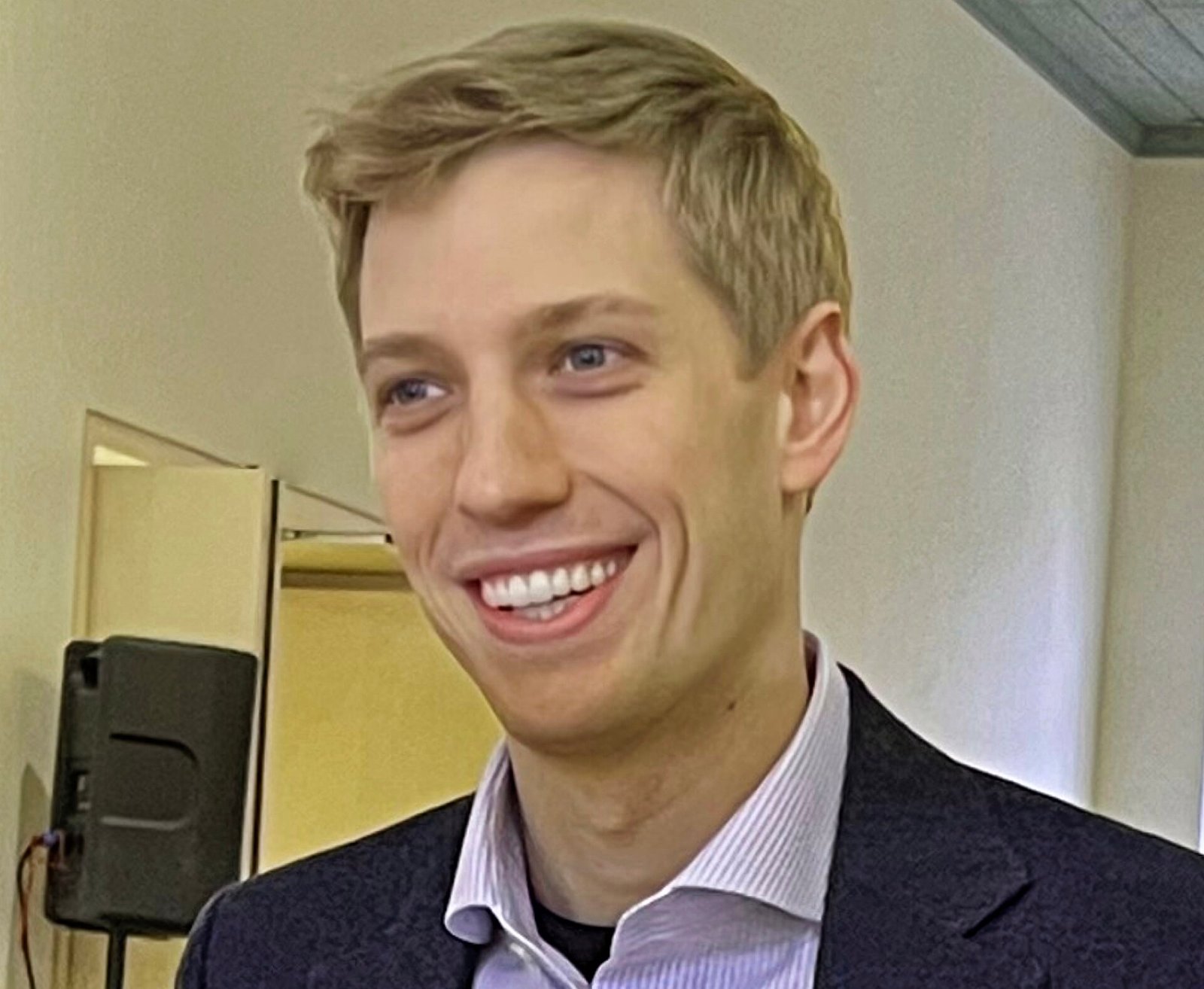

It seemed impossible to compete with the political weight of the incumbent power. However, this energetic and ambitious politician managed not only to refute all pessimistic forecasts but literally to write his name into the history of the Bavarian capital in golden letters.
On this historic Sunday, Krause decided not to rely solely on political slogans, dry rating figures, and chance. To finally secure his electoral success and symbolically gain the support of the city’s higher powers, he performed a deeply personal ritual important to every native resident: he once again cycled on his bicycle to the majestic Munich Residence. There, following a long-standing tradition, he rubbed the nose of the famous bronze lion at the entrance, immediately informing his Instagram followers. Every Munich resident knows—this action brings luck even in the most hopeless and daring undertakings, and for Krause, this gesture became a harbinger of the coming triumph.
And the ancient city omen worked flawlessly. Just a few hours later, Dominik Krause accomplished what only a few weeks ago seemed like a political utopia or an unattainable dream: he won a crushing and absolutely convincing victory over the incumbent head of the city, Dieter Reiter (SPD). Reiter, who for many years was rightfully considered a nearly invincible heavyweight of Munich politics and a symbol of stability, unexpectedly for many conceded his post to his former deputy.
Krause became the first in Munich‘s centuries-old history to represent the ecological party in the highest and most responsible position in the town hall. His success marked a tectonic shift in voter preferences. The results of the second round were more than eloquent and left no room for doubt: 56.4% of the votes for a fresh wind of change and renewal versus 43.6% for maintaining the previous, familiar course. Munich has officially and irrevocably entered a new political era where environmental and social priorities come to the fore.
Celebration for the Greens: “Madness” and “Fantastic”
The atmosphere at the Greens‘ election party on the evening the results were announced resembled not just a political rally, but a triumphal march and a true folk festival. To the thunderous, unceasing chanting of the ecstatic crowd and the sounds of the popular Oktoberfest hit “Bella Napoli,” which became the unofficial anthem of the evening, the new Lord Mayor took the stage.
“Madness” and “simply fantastic”—these were the first words Krause could utter, struggling with great difficulty to restrain sincere jubilation under the bright spotlights and camera flashes. He officially called this day a historical turning point for the entire region and the result achieved a national sensation that would make the political Olympus of Berlin shudder.
The winner expressed deep gratitude to the citizens for the gigantic trust they placed in his hands during this difficult time. In his fiery speech, he promised to direct all his strength, knowledge, and energy to keeping Munich open to the whole world, progressive, tolerant, and diverse.
In his deep conviction, it was the residents’ demand for sincerity, honesty, and inclusiveness that became the main driver of this evening, forever changing the political landscape not only of the capital but of all Bavaria. He emphasized that this result is not just his personal victory, but the victory of every Munich resident who believes in a better future for the city.
The Oktoberfest story and the “open drug scene”
The 35-year-old politician secured his first truly loud headlines in the federal media on March 8. It was then, in the first round, that he did the impossible—forcing the highly experienced Dieter Reiter into an extremely humiliating runoff for a political veteran. Until that moment, he had attracted such close and sometimes critical press attention only once—in 2023, shortly after taking office as the second mayor.
At that time, Krause allowed himself a daring, defiant, and extremely provocative comparison by Bavarian standards. He publicly called the legendary Munich Oktoberfest the world’s largest open drug scene. This phrase then caused a real storm of indignation in conservative circles and among traditionalists, but at the same time attracted the attention of a huge number of young people tired of officialdom.
Now, the irony of fate is that he, the first Green head of the city in history, will have to officially open this great holiday. It is Krause who will stand before the crowd of thousands in the Schottenhamel tent to personally tap the first barrel of beer according to century-old tradition under the world-famous cry “O’zapft is!“.
However, the new mayor is not at all worried about the technical side of this responsible issue: during the intense election campaign, he repeatedly assured journalists and voters that he had practiced diligently and was ready to tap the plug in the perfect two strokes. This is considered an unofficial but mandatory quality standard for any Munich politician claiming public love. His confidence in this matter only adds points in the eyes of those who initially doubted his compliance with traditional Bavarian values.
Krause expressed gratitude to Reiter
Despite his loud and still discussed statement about Oktoberfest, Krause otherwise adhered to a pointedly friendly, constructive, and even cultured style of political struggle throughout the race. In those dramatic moments when his main opponent Reiter stumbled seriously and became the subject of a loud scandal involving paid mandates at the FC Bayern Munich football club, Dominik remained pointedly professional. He never allowed himself to turn to personalities or use dirty tricks, focusing voters’ attention exclusively on program differences, environmental issues, and affordable housing, rather than the private mistakes or misdeeds of his competitor.
Even on the night of his greatest triumph, he made hundreds of supporters and journalists wait for his official appearance on stage. As his spokesperson later reported, Krause felt it necessary first to personally correspond with the defeated Dieter Reiter to express his respect. He addressed his first words of gratitude from the stage specifically to his predecessor and former boss.
He emphasized that the years of their joint interaction in the town hall were constructive and important for the city, calling Reiter a worthy example of conducting high politics. This noble gesture of respect was highly appreciated even by those political opponents from the conservative camp who campaigned against Krause‘s candidacy throughout. Thus, he showed that he is ready to be a mayor for all residents, regardless of their party sympathies.
Krause’s motto: “Because more can be achieved”
While Dieter Reiter‘s entire campaign was built on his personal authority accumulated over decades and was in tune with the famous principle “you know me,” Krause bet on specific content and solving the most painful, everyday city problems. The key and most discussed point of his extensive program was affordable housing. He ambitiously but reasonably promised to build 50,000 new apartments within the city limits to finally stop the uncontrolled growth of rental prices, which literally washes the middle class out of Munich.
If Reiter‘s succinct slogan “It fits” communicated a calm but sometimes passive stability, then Krause‘s motto “Because more can be achieved” promised voters the long-awaited fresh wind and energy in the town hall offices. At the same time, the new mayor does not intend to avoid sharp corners or conflicts at all. When in August 2024 he publicly and boldly spoke out in favor of Munich submitting an official bid to host the Olympic Games, this caused a wave of dissatisfaction even among his fellow party members, who traditionally oppose such mega-projects.
However, his straightforwardness and readiness to defend his position only strengthened his image as a leader of a new type. His open support from Federal Minister Robert Habeck was also a certain risk in conservative Bavaria, where the CSU has been fighting against Habeck‘s policies for years, but in the end, this bet on modern values, honesty, and determination bore fruit, mobilizing the progressive part of the electorate.
“Bürgaimeister” Krause
Dominik Krause, whom the liberal press sometimes affectionately and with a degree of irony calls the “Bürgaimeister,” has lived in the Giesing district for many years with his fiancé Sebastian, who works as a doctor. Their personal story, which began with meeting at ordinary dance classes, added humanity, warmth, and sincerity to the image of the stern politician, making him much closer to ordinary citizens. Immediately after the official announcement of the voting results, he touchingly and publicly thanked the “love of his life” for boundless patience and support. According to him, without this reliable rear, this entire exhausting political marathon would have been simply impossible.
Sebastian became a real pillar for him during the most difficult weeks and months of the campaign when pressure from opponents reached its peak. Krause honestly admitted that due to tight schedules—the intense political and responsible medical ones—very little time for private life had remained lately.
They saw each other less often than they both would have liked but always tried to find moments to support each other. The new head of the city’s hobbies include active recreation in nature: he is an avid lover of hiking in the Alps, enjoys rock climbing, and cannot imagine winter without skiing. This perfectly emphasizes his closeness to nature and the traditional Bavarian lifestyle, in which sports and mountains occupy a central place.
To those critics who still consider him too young and inexperienced for such a high and responsible position, Krause confidently and reasonably reminds them of the great Hans-Jochen Vogel. This legendary SPD politician was elected to the post of head of the Munich town hall in the distant year of 1960, being even a year younger than Krause—at the age of 34. Furthermore, real experience in leading the city during Reiter‘s two-month absence after surgery last year clearly showed that Krause is capable of managing the complex mechanism of a metropolis calmly, confidently, and without any failures.
In the decisive phase before the second round, he actually managed all city affairs independently, as Reiter took a leave of absence to lead his campaign. He intends to embark on his new mission with the necessary humility, deep respect for the office, and readiness to work for the benefit of all citizens without exception.
Election failure for Lord Mayor Reiter
For the entire SPD party, the results of this Sunday’s voting were a real shock, a political earthquake, and a painful blow to pride. Faction leader in the town hall Anne Hübner, not hiding her disappointment, admitted that she did not expect such a catastrophic and obvious gap in the figures, which, she said, causes great pain. Dieter Reiter himself, appearing before supporters in the Oberanger theater a little later, was extremely brief, honest, and self-critical. He publicly admitted his responsibility, pronouncing the heavy words: “I failed everything!”.
The main cause of the fiasco was the scandal with unaccounted income and mandates at the FC Bayern Munich football club, which he did not coordinate with the city council in time.
This oversight finally undermined the trust of Munich residents, who have always been particularly scrupulous in matters of political ethics and government transparency. Reiter made a tough decision and announced the full completion of his long political career that same evening. Despite his last attempts to mobilize the electorate through personal, sometimes very emotional meetings with passers-by in the squares of Maxvorstadt, his time has officially passed. As party veteran Franz Maget later noted with bitterness, even the tactical and strange recommendation for many from the CSU to vote for Reiter did not save the situation—voters simply saw no point in supporting a politician whose methods and leadership style ceased to respond to the spirit of the times and the demands of modern society.
Now, for the Munich SPD, truly difficult and probably long years of regrouping forces and searching for new leaders begin. The party has to analyze the reasons for such a sharp drop in trust and find a new way to the hearts of voters. Nevertheless, the participation of Social Democrats in city management remains not just a possible but a very likely scenario.
Dominik Krause, in his first speech after the victory, has already confirmed that he sees his former colleagues as the most preferred and reliable partners for a new governing coalition. Negotiations on future interaction and distribution of posts in the city council should begin as soon as possible to ensure a smooth transition of power and stable, uninterrupted operation of all municipal services during this transition period.

Latest Posts