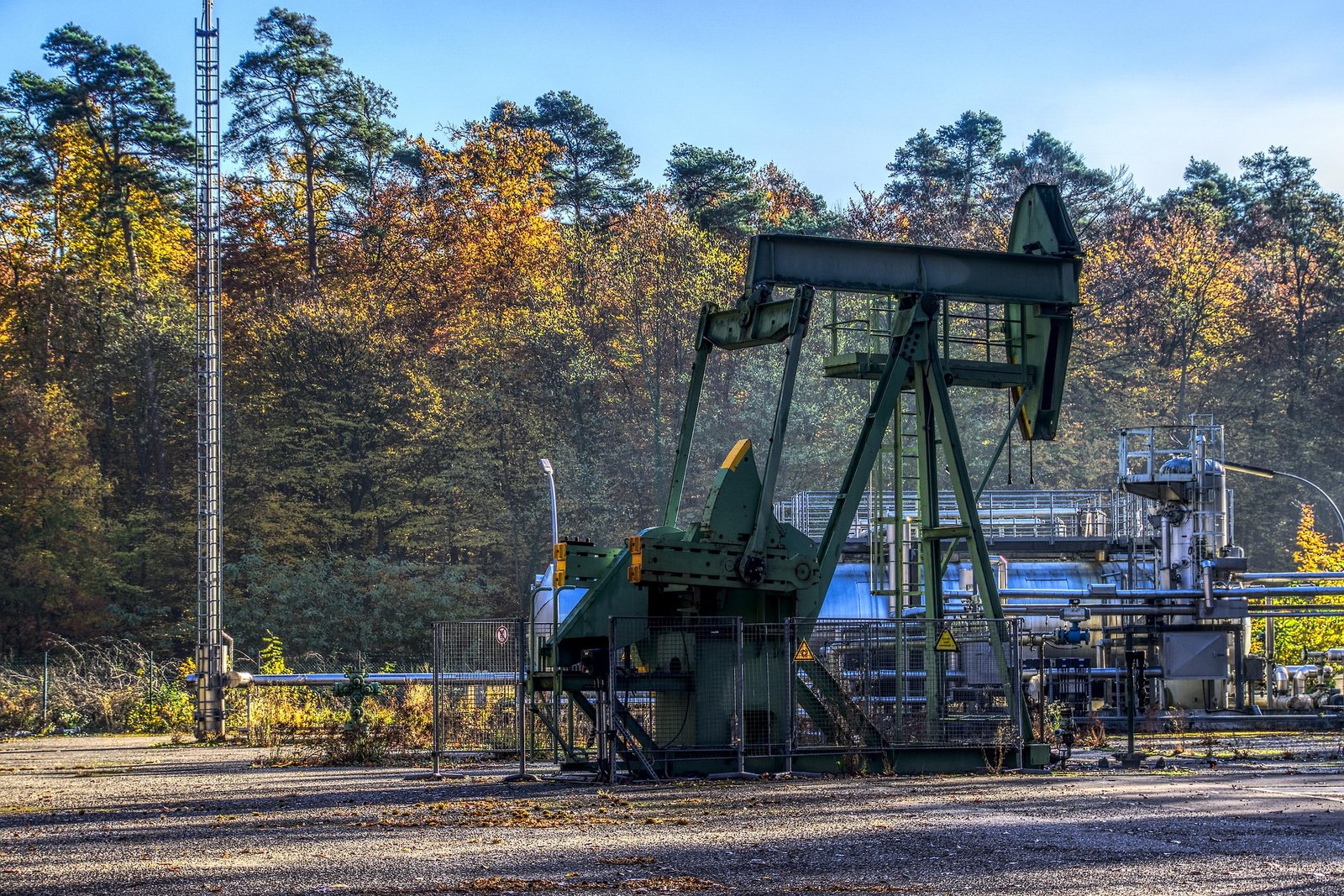

We are looking at a sucker-rod pump, the kind known from oil fields in Texas. But we are not in the USA, and there’s no sign of J.R. Ewing for miles around. We are on the outskirts of Prittlbach, a village of 444 inhabitants near Dachau, and visiting the only active oil field in Upper Bavaria, nestled between cornstalks and barley ears.
Since 1984, the substance has been extracted here from a depth of 1,500 meters – a resource that is not only processed into heating oil or gasoline but also serves as a raw material for the chemical industry. “We took over the Prittlbach oil field from Wintershall Dea in 2020,” Ernst Burgschwaiger, Head of Business Development at ONEO GmbH & Co. KG in Hanover, explains to us at the steel gate. The company specializes in the further development of oil and gas production sites. Then, a firm handshake at the site office container by the gate. “Welcome to Prittlbach!” Bernd Schäfer is the technical manager of ONEO’s oil production facilities in Bavaria.
The company also extracts crude oil in Landau (Palatinate), Schwabmünchen, and Großaitingen (both near Augsburg). “The pump jack makes six and a half strokes per minute, each time lifting two and a half liters,” Schäfer explains. “This adds up to roughly 2,500 tons of crude oil per year.” What’s special about Prittlbach: “Here we have a pure oil content of 45 percent and 55 percent water,” Burgschwaiger adds. For comparison: the oil fields in Swabia yield ten times the volume of liquid, but their pure oil content is only seven percent.
Where does the oil come from? “Twenty-five million years ago, there was a sea between the rising Alps and the mainland in Northern Bavaria and Bohemia, where dead fish and other animals settled on the bottom,” Burgschwaiger explains. “This sea was gradually buried by sand, clay, and gravel. The organic material sank deep and was strongly heated, forming the ‘Fischschiefer’ (oil shale).” The oil migrated into the sandstone layer directly above it, from which it is extracted today. During the Third Reich, initial attempts were made to drill for the oil deposits in the Alpine Foreland, without success. After the war, efforts in Ampfing, Swabia – and Prittlbach were successful. “However, the Ampfing fields were no longer competitive in the 1980s due to low crude oil prices and were abandoned,” Burgschwaiger clarifies.
The oil-water mixture in Prittlbach is pumped into a stainless steel tank. “We heat the pipelines and the tank to 45 degrees Celsius to keep the mixture flowing,” Schäfer tells us. Prittlbach crude contains a lot of paraffin, which is used, for instance, in candle production but becomes quite viscous when cold. “In the tank, the water settles at the bottom and is pumped back into the formation it came from.” At the top, some natural gas separates and is used on-site to heat the facility. A tanker truck collects the crude oil two to three times a week and transports it to the refinery. There is no smell. And beneath the spotless concrete slab on which the production facility stands is a containment basin designed to catch any potential oil spills.
How long the oil field will remain in use is unclear. “For the foreseeable future, it is productive,” says Burgschwaiger. For ONEO, oil production is a declining business model anyway. “Our goal is to repurpose the reservoirs for geothermal energy production after oil extraction.” This is because thermal water deposits lie beneath the oil shale. “We can use the existing boreholes or drill 400 meters further to reach the thermal water.” Projects are already underway in Landau and Ampfing to supply neighboring towns with geothermal energy. Burgschwaiger: “The last oil we extract will finance our contribution to the energy transition.”

Latest Posts