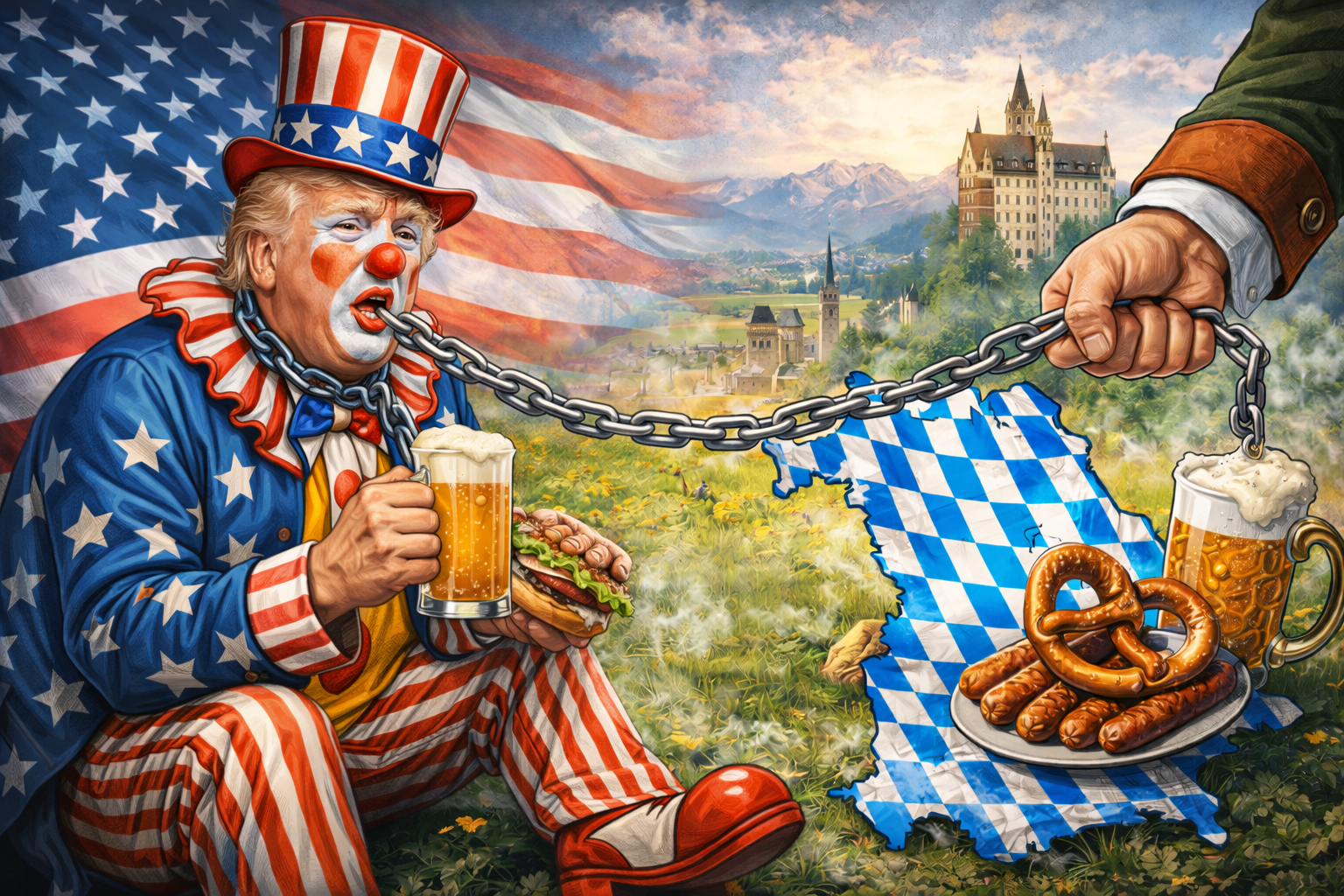

As the US President once again employs tariff threats as a political tool, Berlin intends to signal that such measures are unacceptable. Meanwhile, Bavaria is showing a significant surge in self-confidence regarding its industrial importance.
While US trade partners are accustomed to Washington using tariffs to target sensitive financial sectors, a study by the German Economic Institute (IW) suggests the US may be more vulnerable than it appears. The analysis of American import data indicates that Europe has more room for maneuver due to critical dependencies in Washington.
Entire Product Lines Sourced from Europe
The IW study identified product groups where the US relies heavily on European manufacturers. These are not just individual products but entire statistical categories. In 2024, researchers found 3,120 product groups—with a total volume of approximately $290 billion—where at least 50 cents of every dollar spent on US imports went to the EU. This represents a substantial portion of total American imports and serves as a clear indicator of dependency.
The US Relies on German Manufacturing
As a major export nation, Germany holds a dominant share of these supplies. The study identified 466 product groups where the German share of US imports is at least 50 percent, and in 43 categories, Germany is the sole supplier.
Germany shows particularly high performance in supplying key industrial goods. These include:
- Mobile cranes and concrete pumps.
- Computed tomography (CT) scanners.
- Specialized machine tools.
- High-grade specialty steel.
Behind these categories lie complex production chains that would be nearly impossible for the US to replace quickly.
Strategic Countermeasures: Bavaria’s Key Role
Bavaria stands as a central export hub within these international production networks. If new tariffs lead to supply disruptions, the damage would be felt directly within the US. In political discussions, the list of leverage points gains weight when it considers the supply chains behind the headlines.
In many of these leading categories, Bavaria hosts massive clusters of suppliers. For equipment like industrial components, the dependency involves not just the devices themselves but also essential spare parts and technical maintenance. If US access to these networks is suddenly restricted, it would create a significant deficit that could not be filled in the short term.
Bavarian Economy Warns Against Escalation
Bavarian business leaders are demonstrating much more confidence than a year ago. Bertram Brossardt, Managing Director of the Association of the Bavarian Economy (vbw), stated in response to an inquiry from BR24 that Europe must negotiate with the US from a position of strength. While he noted that demonstrating these strengths is a vital tool, he also warned against escalation, stating that a trade war would be pointless due to mutual dependence. Last year, the US was Bavaria’s largest export market, with a volume of approximately 26 billion euros, while Bavarian companies supported about 728,000 jobs in the US.
Chamber of Commerce Warning: Restrictions Hit Both Sides
The Chamber of Commerce and Industry (IHK) for Munich and Upper Bavaria echoed this sentiment with a crucial warning. Almut Burkhardt told BR24 that while analyzing strategic dependencies is justified, one must remember that many Bavarian companies have invested heavily in the US and produce goods directly there.
In a networked economy, value chains cross the Atlantic in both directions. Broad industrial tariffs would directly impact export-heavy sectors like automotive and mechanical engineering, potentially damaging a company’s own foreign subsidiaries and production sites.
Craft Sector Fears a Chain Reaction
The skilled trades sector also highlighted the risk of a chain reaction. Alexander Tauscher from the Chamber of Skilled Trades for Munich and Upper Bavaria identified specialized machinery, toolmaking, and mechanics as high-risk zones. These businesses often serve as essential suppliers in export chains. If industrial giants reduce investment due to tariffs, orders are delayed, and craft-sector suppliers are the first to feel the impact.Source: BR24, IW Institute