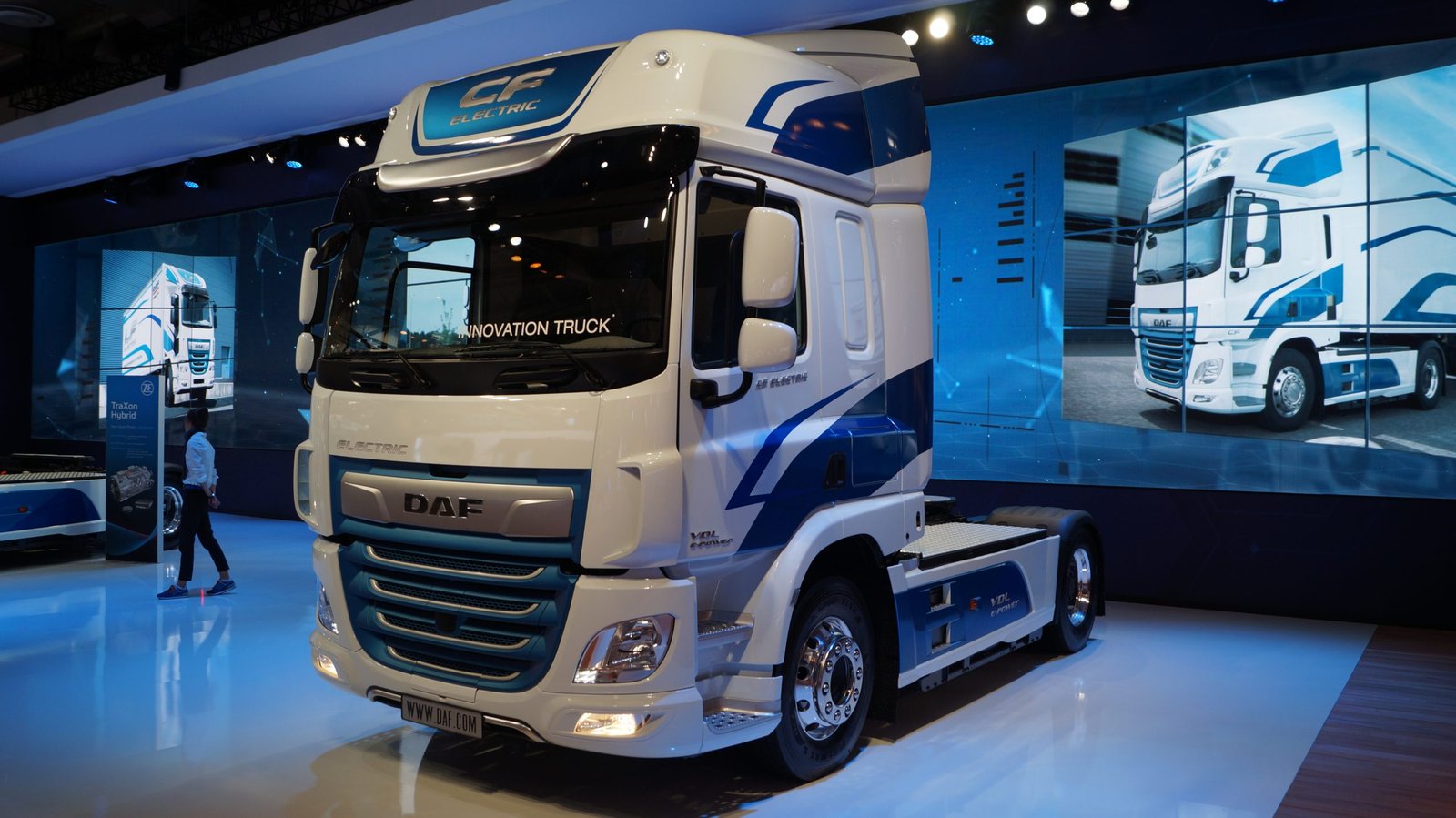

Now, a logistics company in Lower Franconia has taken a major step forward. The firm has largely converted its fleet to electric vehicles and opened the largest private charging park for electric trucks in Bavaria — a potential model for the industry.
Located in Prichsenstadt, the new facility operated by logistics firm W & P features 56 state-of-the-art charging stations, 20 electric trucks, and battery storage units with a total capacity of 15 megawatt-hours. Company owner Alexander Wehr emphasizes the need for long-term thinking: “Half measures won’t help us move forward.” W & P invested around €19 million in the project, which was officially inaugurated last weekend.
Self-Sustaining Power Model Could Break Even in Twelve Years
Wehr expects the investment to pay off within approximately twelve years, primarily due to operational savings. Along with tax and toll exemptions for electric trucks, the firm aims to cover roughly 80% of its electricity needs using its own solar energy. Solar panels with a combined output of 4 megawatts have been installed on the company’s warehouse rooftops. With integrated battery storage, the electric trucks can also be charged overnight.
Wehr anticipates no significant disruptions to operations. The latest generation of electric trucks has a range of about 500 kilometers — roughly equivalent to the average daily distance traveled by conventional trucks. Additionally, mandatory rest breaks can be used for recharging.
Public Infrastructure Still Lags Behind
A major challenge remains the slow development of public charging stations. Of the 351 charging points planned for electric trucks across Germany, only 67 have been completed — just 14 out of 73 in Bavaria. According to the National Charging Infrastructure Control Center, electric truck charging stations require significantly more space and much higher grid capacity, making them harder to implement.
Until the network improves, logistics companies are relying on cooperation. “Can I charge at your station? You can charge at mine,” Wehr explains, highlighting an informal sharing approach. W & P has also installed additional chargers at its loading docks, allowing trucks to recharge while being unloaded. The company plans to grow its electric fleet to 42 trucks over time.
Industry Associations Urge Caution
Despite such progress, industry associations remain cautious. Sabine Lehmann of the Bavarian Hauliers Association (LBS) warns that “the transition to e-mobility will take decades.” Without government subsidies, the switch is financially unfeasible for most firms. Current economic uncertainties also make long-term investment planning difficult for many businesses.
International freight carriers face even greater obstacles, particularly in Eastern Europe, where the charging infrastructure is nearly nonexistent. While an EU regulation passed in 2024 requires charging stations every 60 kilometers along key corridors by 2030, the rollout remains slow. Lehmann considers the plan “a good idea” but “an insufficient basis for immediate investment decisions.”
Freight Association Calls for National Strategy Meeting
Electric trucks are not only significantly more expensive — costing two to three times more than diesel trucks — but also heavier by about four tons. Dirk Engelhardt, spokesperson for the Federal Association for Road Haulage, Logistics and Disposal (BGL), is calling for policy solutions to offset the added weight so that vehicle limits and infrastructure are not overstressed. The BGL is advocating for a national commercial vehicle summit involving government ministries and energy providers.
Government Subsidies Play a Key Role
Since 2023, Bavaria’s “Electromobility Competence Center,” part of Bayern Innovativ GmbH, has supported private, non-public charging stations. W & P’s project received €500,000 in funding for 16 of its charging points. Project manager Bastian Ritter describes the new hub in Prichsenstadt as a “lighthouse project,” highlighting its potential to elevate electrification efforts across the logistics industry. Targeted support could make the switch to electric mobility viable even for smaller logistics firms.

Latest Posts